


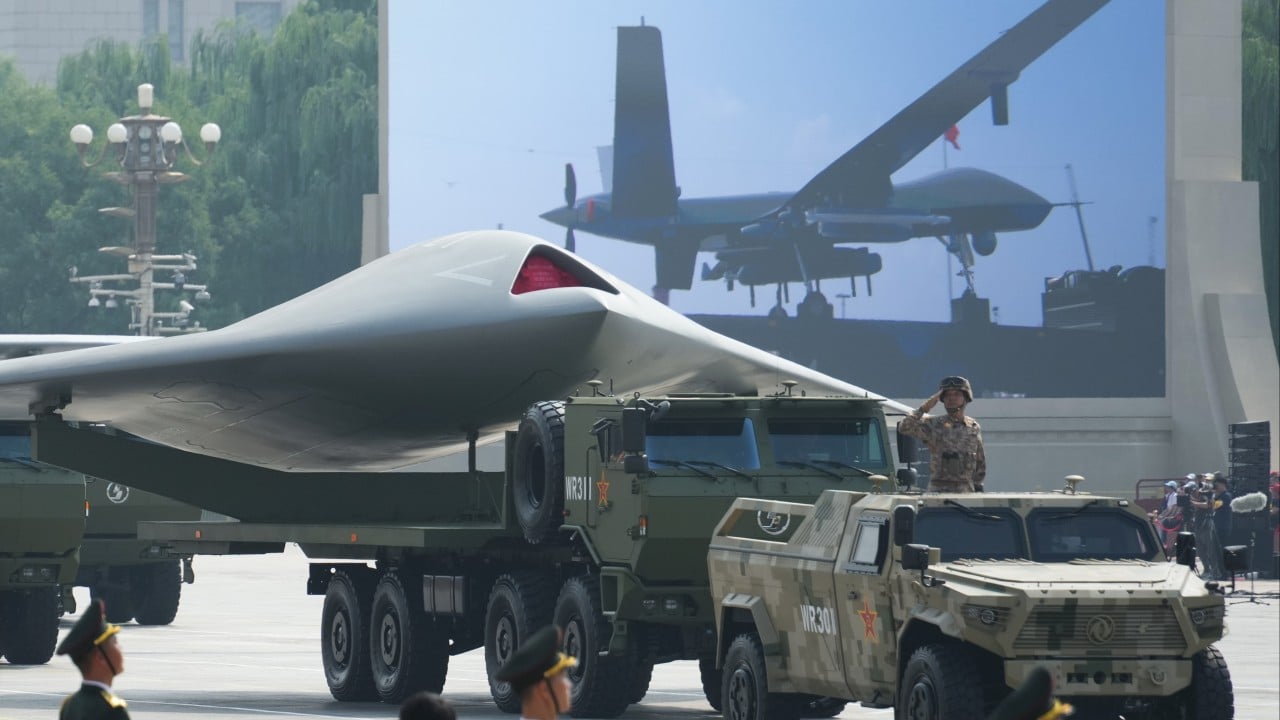
China’s ‘land aircraft carrier’ charges flying drone with microwave beam
Summarized and contextualized by DistantNews.
TLDR
- Chinese scientists have demonstrated a wireless power transmission system capable of beaming microwave energy to drones in motion, enabling indefinite flight.
- The system, likened to a 'land-based aircraft carrier,' uses a ground-based emitter to charge an antenna array on the drone's underside.
- Tests showed fixed-wing drones staying airborne for up to 3.1 hours at an altitude of 15 meters, overcoming the challenge of maintaining alignment during flight.
A groundbreaking development in drone technology is emerging from China, with scientists successfully demonstrating a wireless power transmission system. This innovation allows a ground-based microwave emitter to beam energy to drones, effectively enabling them to fly indefinitely. The system has been conceptually compared to a 'land-based aircraft carrier,' suggesting its potential as a mobile command and energy node for ground forces, capable of sustaining drone operations for extended periods.
A vehicle that can zap energy into a fleet of drones, allowing them to fly indefinitely, is getting closer to becoming a battlefield reality.
Researchers from Xidian University, a prominent institution in military technology research, published their findings in the journal Aeronautical Science & Technology. Their tests involved a car-mounted system that kept fixed-wing drones airborne for over three hours at a modest altitude. The critical breakthrough was overcoming the challenge of maintaining precise alignment between the moving emitter and the drone during flight, a feat achieved through the integration of GPS positioning, dynamic tracking, and onboard flight controls.
Some analysts have likened the concept to a “land-based aircraft carrier”, in which an armoured vehicle could function as a mobile command and energy node, launching and sustaining drones much just as naval carriers support aircraft.
This advancement holds significant implications for military applications, potentially extending the operational reach of ground forces. Persistent surveillance, airborne attacks, and electronic warfare capabilities could be greatly enhanced by such systems. The ability to provide continuous power to drones without the need for frequent landings or battery swaps represents a major leap forward in unmanned aerial vehicle technology, bringing a new dimension to battlefield capabilities.
The key challenge that the team overcame was maintaining alignment between the emitter and the drone during flight.
DistantNews Editorial
Originally published by South China Morning Post. Summarized and contextualized by our editorial team with added local perspective. Read our editorial standards.
More Stories


From Our Blog

Countries Without a Free Press: What You Need to Know

What Press Freedom Means for the News You Read

What Gets Lost (and Found) When News Is Translated

The Critical Role of Diaspora Media in Global News

What Travellers Should Know About Countries with Restricted Press
