


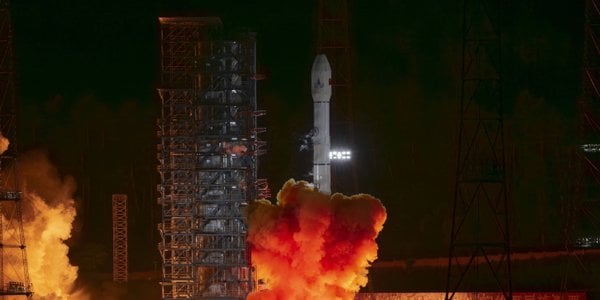
China's Tianwen-2 probe reaches asteroid after billion-kilometer journey
Translated from Polish, summarized and contextualized by DistantNews.
At a glance
News
Named sources
New plan
- China's Tianwen-2 probe has reached asteroid 469219 Kamo'oalewa after a 400-day journey covering one billion kilometers.
- The probe will now study the asteroid's morphology, chemical composition, and internal structure, and plans to collect samples.
- If successful, China would be the third nation, after Japan and the US, to achieve such a sample return mission.
China's Tianwen-2 probe has successfully reached the near-Earth asteroid 469219 Kamo'oalewa, marking a significant milestone in the nation's ambitious deep space exploration program. The probe embarked on its 400-day, one-billion-kilometer journey on May 29, 2025, and has now begun its scientific mission.
The primary objective of Tianwen-2 is to investigate the asteroid's morphology, chemical composition, and internal structure. Initial imaging data has already been acquired as the probe approached the 40-100 meter diameter object, which is classified as a quasi-moon. Some scientists speculate that Kamo'oalewa might be a fragment of the Moon ejected by a meteorite impact.
Following its close-range study, Tianwen-2 is tasked with collecting rock samples. These samples are scheduled to be returned to Earth in a specialized capsule by the end of 2027. Should this mission succeed, China would join Japan and the United States as the only countries to have successfully completed an asteroid sample return mission.
Beyond its work at Kamo'oalewa, Tianwen-2 has a secondary objective: to journey towards the comet 311P, also known as an "active asteroid." Studying this comet up close aims to enhance scientific understanding of the boundary between asteroids and comets, and to investigate the formation mechanisms of water and ice within the solar system. This mission follows China's successful placement of a rover on Mars in 2021 and precedes a planned 2028 mission to return Martian samples.
During the approach to the asteroid, the probe has already obtained its first imaging data.
DistantNews Editorial
Originally published by Rzeczpospolita in Polish. Translated, summarized, and contextualized by our editorial team with added local perspective. Read our editorial standards.
More Stories



From Our Blog

What Gets Lost (and Found) When News Is Translated

The Critical Role of Diaspora Media in Global News

What Travellers Should Know About Countries with Restricted Press

A Digital Nomad's Guide to Following Local News

How the Same Story Looks Different in Different Countries
