


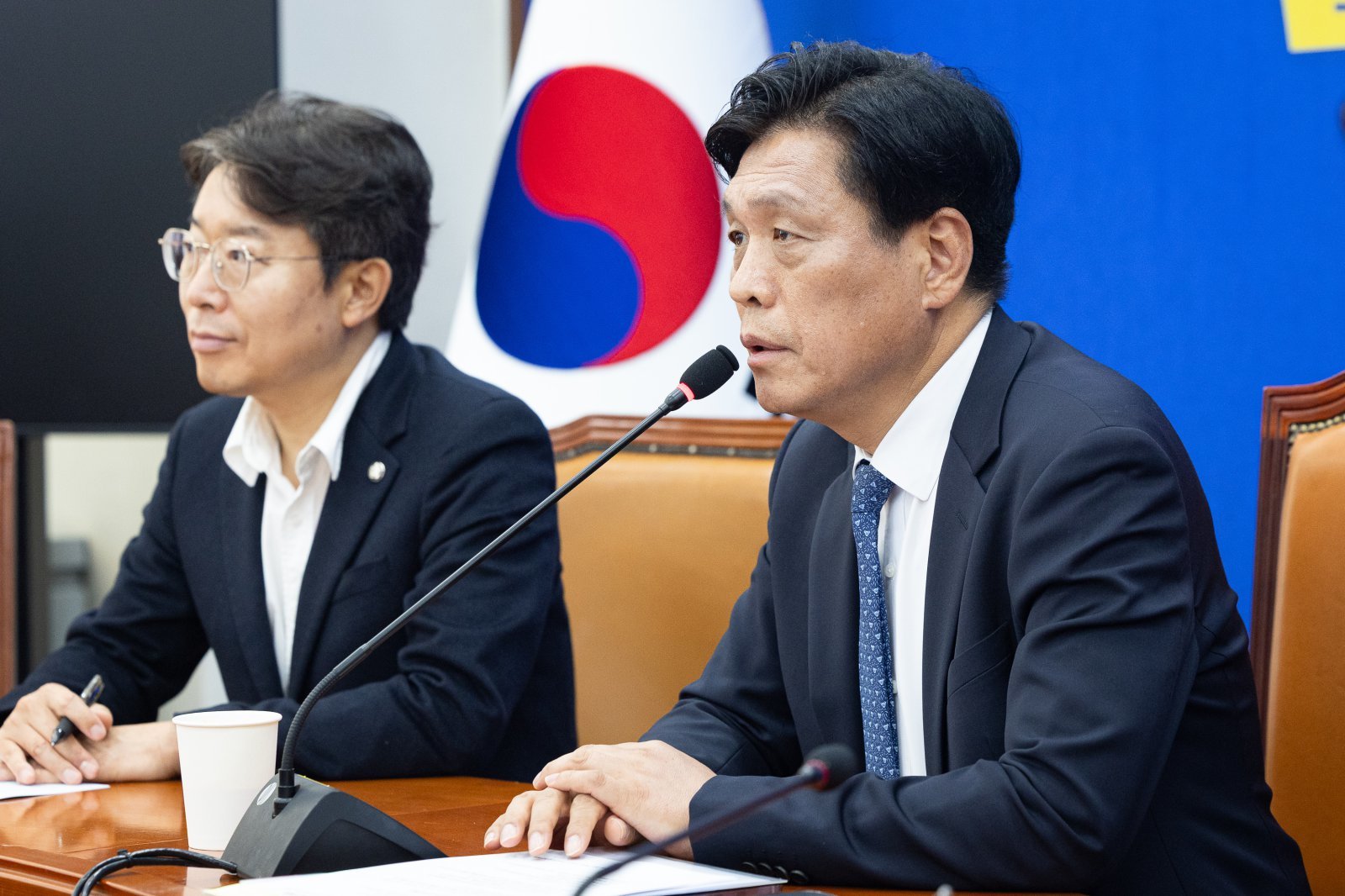
Cho Seung-rae: No 'give-and-take' single candidate endorsements; Kim Kwan-young's independent run talk is baffling
Translated from Korean, summarized and contextualized by DistantNews.
TLDR
- The Democratic Party's Secretary-General, Cho Seung-rae, stated there will be no "give-and-take" style single candidate endorsements with the Jo Guk Innovation Party.
- He clarified that the nomination of Kim Yong-nam for the Pyeongtaek B constituency was based on internal party assessment, not external party relations.
- Cho expressed confusion over Kim Kwan-young's talk of running as an independent candidate following his apology for alleged misconduct.
From the perspective of Dong-A Ilbo, a South Korean newspaper often reflecting a more conservative or mainstream political viewpoint, the statements by Democratic Party Secretary-General Cho Seung-rae reveal a party attempting to navigate complex electoral alliances while asserting its independence. Cho's firm stance against "give-and-take" single candidate endorsements with the Jo Guk Innovation Party is a clear signal that the Democratic Party intends to maintain its own strategic direction, particularly in key constituencies like Pyeongtaek B, where a Jo Guk Innovation Party candidate is also running.
Kim Yong-nam was nominated for Pyeongtaek B because we judged him to be sufficiently competitive and capable of winning.
The party's decision to nominate Kim Yong-nam for Pyeongtaek B is presented as an internal judgment based on competitiveness, deliberately decoupling it from inter-party negotiations. This approach aims to project an image of decisiveness and self-reliance, suggesting that the Democratic Party is not merely reacting to or accommodating other political forces but is charting its own course. The emphasis on Kim Yong-nam's individual campaign efforts further reinforces this narrative of internal strength and strategic nomination.
There is no coordination or adjustment at the central party level regarding electoral alliances.
Furthermore, Cho Seung-rae's comments on the controversy surrounding Jeonbuk governor candidate Lee Won-taek and the remarks about Kim Kwan-young highlight the internal challenges and political maneuvering within the broader opposition bloc. The party's assertion that Lee Won-taek's nomination was thoroughly vetted, coupled with Cho's expressed bewilderment at Kim Kwan-young's talk of independent candidacy after an apology, points to a desire to maintain party discipline and address internal disputes decisively. This reflects a broader political climate in South Korea where intra-party dynamics and inter-party relationships are constantly scrutinized, especially in the lead-up to elections.
We conducted a thorough investigation into candidate Lee Won-taek's case, and the results confirmed no issues.
From a South Korean political lens, these statements are not just about specific nominations or alliances; they are about the Democratic Party's positioning and strategy within a highly competitive political landscape. The party seeks to balance cooperation with other opposition forces against the need to assert its own identity and electoral strength, a delicate act that often defines the success or failure of political coalitions. The coverage here emphasizes the party's internal decision-making processes and its public messaging strategy in managing these complex relationships.
Suddenly talking about running as an independent is difficult to understand.
DistantNews Editorial
Originally published by Dong-A Ilbo in Korean. Translated, summarized, and contextualized by our editorial team with added local perspective. Read our editorial standards.
More Stories

From Our Blog

What Gets Lost (and Found) When News Is Translated

The Critical Role of Diaspora Media in Global News

What Travellers Should Know About Countries with Restricted Press

A Digital Nomad's Guide to Following Local News

How the Same Story Looks Different in Different Countries
