


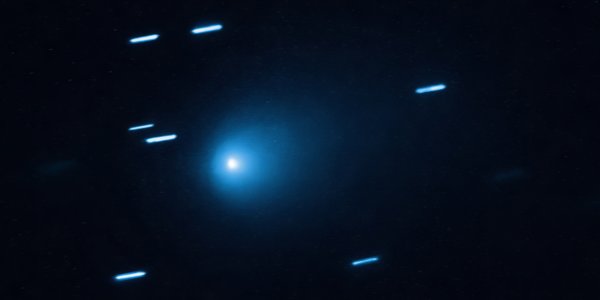
Comet 3I/Atlas Surprises Scientists with New Research Findings
Translated from Polish, summarized and contextualized by DistantNews.
At a glance
News
Sources not specified
Context piece
- Comet 3I/Atlas, the third interstellar object observed from Earth, may be as old as 12 billion years, predating our solar system.
- Analysis of its chemical composition, particularly a high concentration of deuterium, suggests it formed in an extremely cold environment.
- Scientists are eager to discover more interstellar objects, anticipating new insights into galactic formation and evolution.
Comet 3I/Atlas has surprised scientists with its potential age and origin, offering a rare glimpse into the conditions of the early solar system and beyond. As the third interstellar object detected passing through our solar system, its composition has provided crucial data for researchers.
Recent studies published in "Nature" suggest 3I/Atlas could be up to 12 billion years old, significantly older than our own solar system, which formed about 4.5 billion years ago. This age estimate is based on isotopic analysis conducted using the James Webb Space Telescope and the Alma observatory in Chile. The comet contains ten times more deuterium, a heavy isotope of hydrogen, than comets originating within our solar system.
Martin Cordiner of NASA's Goddard Space Flight Center explained that such a high deuterium content indicates the comet likely formed in an extremely cold environment, possibly as cold as minus 243 degrees Celsius. This makes 3I/Atlas one of the coldest objects ever observed within our solar system. While its precise origin remains unknown, scientists theorize that interstellar objects like it form similarly to comets in other solar systems, ejected during the formation of new planets.
Astronomers anticipate discovering more interstellar objects in the coming years, especially with the advent of new observatories like the Vera C. Rubin Observatory. Cordiner stated, "This is just the beginning of a new, exciting field; we still have much to learn about these objects and what they can tell us about our galaxy." The study of these ancient travelers promises to deepen our understanding of galactic chemistry and the conditions under which planetary systems form.
DistantNews Editorial
Originally published by Rzeczpospolita in Polish. Translated, summarized, and contextualized by our editorial team with added local perspective. Read our editorial standards.
More Stories



From Our Blog

What Gets Lost (and Found) When News Is Translated

The Critical Role of Diaspora Media in Global News

What Travellers Should Know About Countries with Restricted Press

A Digital Nomad's Guide to Following Local News

How the Same Story Looks Different in Different Countries
