

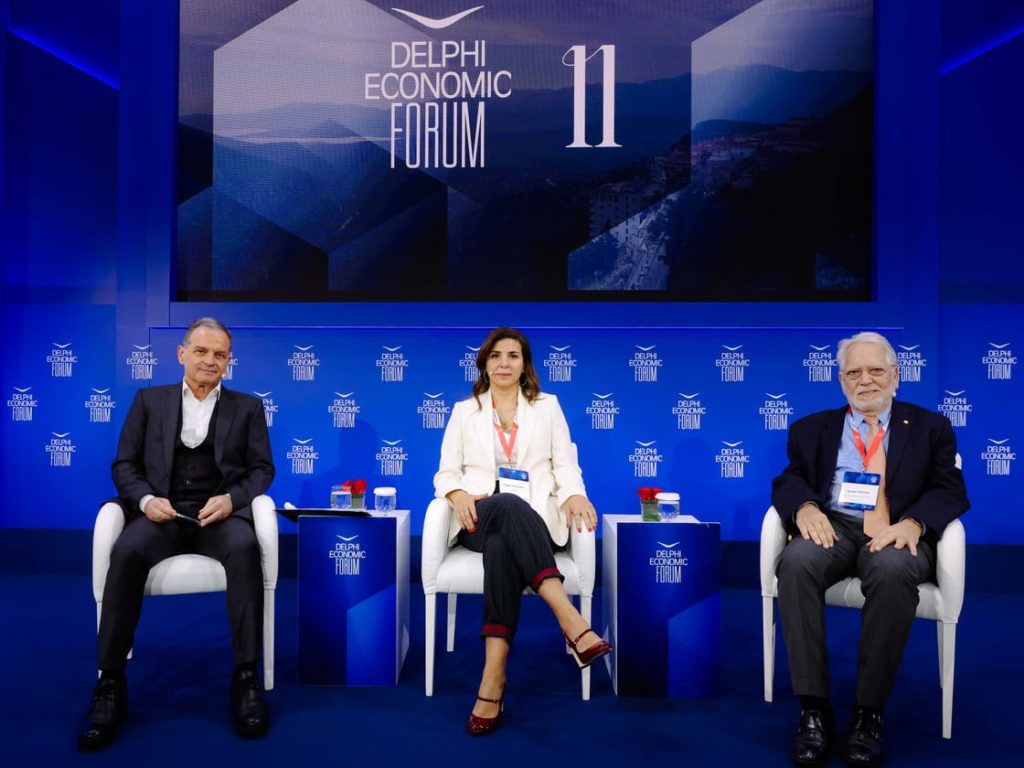

Delphi Economic Forum: AI Inaction Costs More Than Investment
Translated from Greek, summarized and contextualized by DistantNews.
TLDR
- The cost of inaction in artificial intelligence (AI) now exceeds the cost of investment, a key message from the 11th Delphi Economic Forum.
- Greece is finalizing its national AI framework, focusing on transparency, accountability, and distinguishing human from AI-generated content.
- Businesses need to strategically integrate AI into their operational models, not just use it as a tool, to remain competitive.
At the 11th Delphi Economic Forum, a critical message resonated: the price of neglecting artificial intelligence development is now steeper than the investment required. This sentiment underscores Greece's strategic approach to AI, as highlighted by Deputy Development Minister Stavros Kalafatis. He emphasized that AI is a foundational element for a new productive model, necessitating policy axes ranging from institutional stability and EU harmonization to infrastructure, research-market links, investment incentives, and crucial skills upgrades, with over 40% of the workforce needing retraining.
the cost of inaction is much greater than the cost of investment in artificial intelligence
Greece is actively shaping its national AI landscape. Vassilis Karkazis, Special Secretary for AI and Data Governance, indicated that the country is in the final stages of adapting to the EU's AI Act. Key challenges revolve around ensuring transparency, accountability, and technical robustness, particularly in discerning AI-generated content. The ministry is promoting a public registry of AI systems to mitigate risks associated with excessive or undefined AI use.
structural element of a new productive model
From the business perspective, Yannis Andronopoulos, CEO of Microsoft Greece, Cyprus, and Malta, stressed that future success lies not in merely using AI tools, but in strategically embedding AI into core business models. AI is evolving into a decision-making infrastructure, demanding robust security, data management, and skill development. The question is no longer *if* AI will be used, but *how* it will be leveraged to create value.
over 40% of employees need retraining
Michalis Georgakopoulos, CEO of Satori Analytics, focused on the return on investment, cautioning that fragmented pilot projects yield little. True transformation requires strategic targeting, high-quality data (avoiding "garbage in, garbage out"), and, crucially, an adaptive organizational culture. AI fundamentally alters operational models, demanding time and adjustment. Thanos Falagas of COSMOTE-TELEKOM presented a three-tiered development model based on infrastructure, platforms, and data services, reinforcing that data is the essential fuel for this AI-driven evolution.
in the final stages of formulating the national framework for adaptation to the AI Act
DistantNews Editorial
Originally published by Ta Nea in Greek. Translated, summarized, and contextualized by our editorial team with added local perspective. Read our editorial standards.
More Stories



From Our Blog

What Gets Lost (and Found) When News Is Translated

The Critical Role of Diaspora Media in Global News

What Travellers Should Know About Countries with Restricted Press

A Digital Nomad's Guide to Following Local News

How the Same Story Looks Different in Different Countries
