

Dominican Painting Caught in Trump’s Culture War
Translated from Spanish and summarized by DistantNews. Read the original for the full story.
At a glance
Analysis
Named sources
Ongoing story
- U.S. Ambassador Leah Campos removed Kehinde Wiley’s painting "Young Artists After Siamesas 1960" from the embassy in Santo Domingo.
- Campos framed the removal as a rejection of "globalist and woke" ideologies, while Art in Embassies director Erin Scavino called the work "very woke" and "aesthetically terrifying."
- The U.S. State Department is considering whether to sell the painting, which depicts four Dominican artists and was commissioned in 2013.
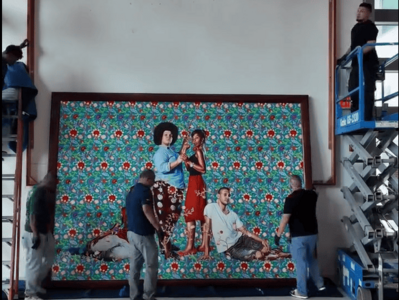
A monumental painting of four young Dominican artists has become a symbol in the American culture war after its removal from the U.S. Embassy in Santo Domingo.
Kehinde Wiley’s "Young Artists After Siamesas 1960" shows the artists against a background of sunflowers, peonies and tulips. The U.S. State Department commissioned it in 2013 for the Art in Embassies program, after Wiley studied the work of Dominican artists Celeste Woss y Gil and Gilberto Hernández Ortega.
globalist and woke
Ambassador Leah Campos posted a video of the removal on Aug. 11. Covered by a tarp printed with the U.S. flag, the painting was lowered from the building on a lift while Twisted Sister’s "We’re Not Gonna Take It" played. Campos said the embassy was leaving behind "globalist and woke" ideologies and embracing "American patriotism."
American patriotism
Erin Scavino, the Art in Embassies director and wife of presidential deputy chief of staff Dan Scavino, described the work as "very woke" and "aesthetically terrifying." The State Department is now considering whether it can sell the painting.
The controversy has reached U.S. media and publications in the Dominican Republic, Britain and Spain. The New York Times noted that the painting itself contains nothing obviously subversive: four fully dressed, largely expressionless people stand in a floral setting. The article’s central argument was that "the meaning of this removal lies in the psychology, more than in the painting."
very woke
The criticism does not amount to an unqualified defense of Wiley. The coverage also describes his repeated formula of placing mainly Black young people in poses derived from European historical painting, often against ornamental backgrounds, with some production carried out by assistants in China and elsewhere. Critic Rachel Hunter Himes called it "a kind of court style of the Obama era."
a kind of court style of the Obama era
About this summary
Originally published by Diario Libre in Spanish. Translated, summarized, and contextualized automatically by DistantNews, with a note on how the source frames the story. Not individually reviewed before publishing. How this works.
More Stories


From Our Blog

What Gets Lost (and Found) When News Is Translated

The Critical Role of Diaspora Media in Global News

What Travellers Should Know About Countries with Restricted Press

A Digital Nomad's Guide to Following Local News

How the Same Story Looks Different in Different Countries
