

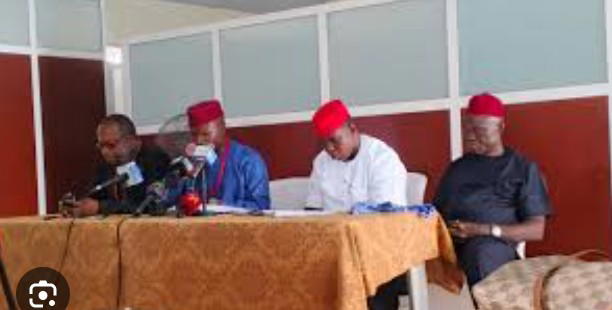

Ex-envoy, others call for Nigeria's restructuring amid insecurity
Translated from English, summarized and contextualized by DistantNews.
TLDR
- Former Nigerian Ambassador Yemi Farounbi called for urgent restructuring of Nigeria's governance architecture to address rising insecurity and strains on its democratic system.
- He stated that Nigeria's abundant resources have not translated into development due to structural deficiencies, weak institutions, and poor policy implementation, with insecurity being the clearest indicator of systemic failure.
- The article also touches on the fragility of Nigeria's democracy despite uninterrupted electoral cycles since 1999, citing issues like elite dominance and economic hardship.
Nigeria's governance architecture is at a critical juncture, facing unprecedented challenges that demand immediate and fundamental restructuring. As highlighted at a recent symposium in Ibadan, the nation's abundant resources remain tragically untapped, a paradox stemming from deep-seated structural deficiencies, institutional weaknesses, and a persistent lack of accountability.
Nigeria is a nation of paradox. The country’s abundant human and natural resources have not translated into meaningful development due to structural deficiencies, weak institutions, and poor implementation of policies.
The most glaring symptom of this systemic rot is the pervasive insecurity plaguing the country. This is not merely a law-and-order issue; it is a profound indicator of a failing state. The former Ambassador, Yemi Farounbi, rightly pointed out that progress is impossible when the security apparatus is weak and fragmented. This resonates deeply within Nigeria, where citizens experience the daily consequences of this instability.
Nigeria’s challenges are not rooted in a lack of knowledge or ideas, but in a persistent absence of discipline, accountability, and effective institutional structures. Nigeria’s problem is not the absence of solutions, but the absence of structure and responsibility to implement those solutions.
While international observers may focus on electoral processes, we in Nigeria understand that the true health of our democracy lies beyond the ballot box. The "Fourth Republic," as discussed by Segun Showunmi, has achieved electoral continuity but lacks genuine democratic depth. Issues like elite capture, weak party structures, economic hardship, and declining public trust erode the legitimacy of our governance. This internal perspective is often missed by external reporting, which may not grasp the nuances of our struggle for substantive democratic consolidation.
Insecurity remains the clearest indicator of systemic failure, and no nation can make progress when its security architecture is weak and its institutions are fragmented.
This situation demands a collective national responsibility. The failure of Nigeria is, as Ambassador Farounbi stated, the failure of its people. We must embrace reforms that strengthen our institutions, foster accountability, and rebuild public trust. The path forward requires not just ideas, but the discipline and political will to implement them, a challenge that defines our current national discourse.
the failure of Nigeria is the failure of its people
DistantNews Editorial
Originally published by The Punch in English. Translated, summarized, and contextualized by our editorial team with added local perspective. Read our editorial standards.
More Stories


From Our Blog

How the Same Story Looks Different in Different Countries

What Gets Lost (and Found) When News Is Translated

The Critical Role of Diaspora Media in Global News

What Travellers Should Know About Countries with Restricted Press

A Digital Nomad's Guide to Following Local News
