


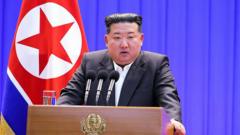
Executions in North Korea ramped up significantly during pandemic - report
Summarized and contextualized by DistantNews.
TLDR
- Executions in North Korea increased significantly during the COVID-19 pandemic, with at least 153 people executed or sentenced to death between January 2020 and the end of 2024.
- This marks a sharp rise compared to the 44 individuals executed in the five years preceding the pandemic.
- Common offenses leading to execution included religious activities, superstition, and consumption of foreign cultural content, such as K-dramas and K-pop.
A recent report by the Seoul-based Transitional Justice Working Group (TJWG) reveals a disturbing trend: North Korea dramatically escalated executions during the COVID-19 pandemic. Between January 2020 and the end of 2024, an estimated 153 individuals faced execution or received death sentences. This figure represents a stark increase from the 44 people executed in the five years prior to the pandemic, indicating a tightening grip on the population under the guise of border security and ideological purity.
North Korea executed a total of 358 people were executed between 2011 and 2024, according to an NGO report
The report, compiled from testimonies of over 250 North Korean defectors, highlights that offenses related to religion, superstition, and the consumption of foreign cultural content—particularly South Korean K-dramas and K-pop—were among the most common reasons for capital punishment. This focus on cultural imports underscores Kim Jong Un's regime's deep-seated fear of external influence eroding its tightly controlled ideology. The crackdown intensified after Pyongyang sealed its borders in 2020, suggesting a correlation between isolation and increased repression.
Executions rose sharply in North Korea during the Covid-19 pandemic, according to a Seoul-based NGO.
While executions had seen a decline between 2015 and 2019, partly in response to international pressure following a landmark UN inquiry into human rights abuses, the pandemic provided a pretext for their resurgence. The TJWG documented at least 54 executions in 2020 and 45 the following year, a significant jump from the average of five per year between 2016 and 2019. This surge demonstrates the regime's willingness to employ extreme measures to maintain political dominance and ideological control, especially as it navigates potential leadership succession.
Some of the most common offences were related to religion, superstition and foreign cultural content - including the consumption of K-dramas and K-pop.
From our perspective in Seoul, this report serves as a grim reminder of the ongoing human rights crisis within North Korea. While international attention often focuses on the regime's nuclear program, the systematic use of the death penalty against its own citizens, particularly for perceived ideological transgressions, is a critical issue that demands sustained scrutiny. The report's mapping of 46 execution sites across the country, and the finding that over 70% of executions are public and carried out by firing squad, paints a chilling picture of state-sanctioned terror. The TJWG's work is invaluable in bringing these hidden realities to light, offering a crucial counter-narrative to Pyongyang's carefully curated image.
As the regime pursues a 4th hereditary succession of power, there is a high risk of increased executions to strengthen cultural and ideological control and maintain political dominance.
DistantNews Editorial
Originally published by BBC News. Summarized and contextualized by our editorial team with added local perspective. Read our editorial standards.
More Stories


From Our Blog

What Gets Lost (and Found) When News Is Translated

The Critical Role of Diaspora Media in Global News

What Travellers Should Know About Countries with Restricted Press

A Digital Nomad's Guide to Following Local News

How the Same Story Looks Different in Different Countries
