


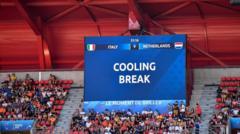
Extreme Weather Poses Threat to 2026 World Cup; FIFA Implements Cooling Breaks
Translated from English, summarized and contextualized by DistantNews.
TLDR
- Extreme weather conditions, including heat, thunderstorms, and poor air quality, pose a significant risk to the 2026 World Cup in the US, Canada, and Mexico.
- FIFA has introduced mandatory three-minute cooling breaks in each half of matches due to concerns about player welfare in high temperatures.
- Several host cities are expected to experience extreme heat stress, with Wet Bulb Globe Temperatures potentially reaching dangerous levels.
As the world's biggest football spectacle, the 2026 World Cup, approaches, a looming concern threatens to disrupt the tournament: extreme weather. The host nations – the United States, Canada, and Mexico – are bracing for a summer characterized by intense heat, volatile thunderstorms, and potentially hazardous air quality stemming from wildfires.
FIFA has acknowledged the potential impact of these conditions on player performance and well-being. In a proactive measure to safeguard athletes, mandatory three-minute cooling breaks have been implemented in each half of every match. This decision follows incidents during the 2025 Fifa Club World Cup, where heat and thunderstorms caused multiple delays, prompting one manager to question the suitability of the US as a host location.
The forecast for many host cities is daunting. Average daytime temperatures in southern US and northern Mexico regions are expected to hover in the low to mid-30s Celsius (mid-90s Fahrenheit), with potential spikes nearing 40C (104F). When combined with high humidity, the perceived temperature, or 'feels like' temperature, can soar, making it significantly harder for the human body to regulate its temperature. For instance, a 32C (90F) day in Miami could feel like 43C (109F).
Scientific assessments, such as the Wet Bulb Globe Temperature (WBGT), which measures heat stress on the body, indicate a serious risk. A 2025 study revealed that 14 out of 16 host locations exceeded the critical WBGT threshold of 28C (82F) during summer afternoons. Six cities, including Miami, Houston, Dallas, Monterrey, Kansas City, and Atlanta, could face WBGT levels of at least 32C (90F), signifying extreme heat stress. To mitigate these risks, match schedules are being adjusted, with many kick-offs planned for the cooler late afternoon or evening hours.
The US is probably not the right place to do the competition.
DistantNews Editorial
Originally published by BBC News in English. Translated, summarized, and contextualized by our editorial team with added local perspective. Read our editorial standards.
More Stories



From Our Blog

What Gets Lost (and Found) When News Is Translated

The Critical Role of Diaspora Media in Global News

What Travellers Should Know About Countries with Restricted Press

A Digital Nomad's Guide to Following Local News

How the Same Story Looks Different in Different Countries
