

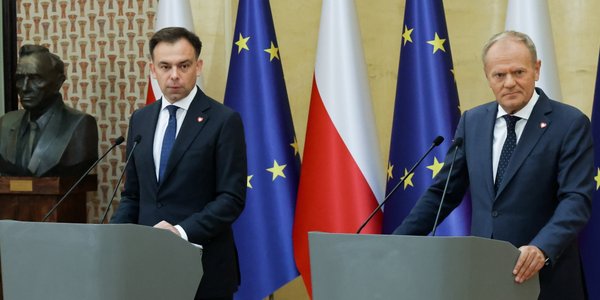

Fitch Affirms Poland's Rating but Warns of Negative Outlook Amid Fiscal Woes
Translated from Polish, summarized and contextualized by DistantNews.
At a glance
News
Sources not specified
Context piece
- Fitch Ratings affirmed Poland's credit rating but maintained a negative outlook due to concerns over public finances.
- The agency cited Poland's high budget deficit and rising public debt as key challenges, projecting continued deficits and debt growth through 2028.
- Fitch highlighted political tensions and upcoming elections as factors hindering the implementation of fiscal consolidation strategies.
Fitch Ratings has affirmed Poland's credit rating, but the agency maintained a negative outlook, signaling ongoing concerns about the country's public finances. The decision, largely anticipated by economists and the market, reflects a complex economic picture where solid growth and controlled inflation are weighed against a deteriorating fiscal situation.
At the moment, nothing dramatic has happened since the previous review in February. Agencies are paying attention to the deficit level, but at the same time, economic growth remains very solid, and we have inflation under control despite the perturbations related to the war in Iran.
The agency's report specifically points to Poland's significant budget deficit, which reached 7.3% of GDP in 2025, the highest in 15 years. Public debt also stands at 59.7% of GDP. Fitch forecasts only a slight consolidation in the coming years, with deficits projected to remain around 6.9% in 2026 and 6.7% in 2027. The outlook for 2028 is even more concerning, with Fitch predicting a fiscal deficit of 6.1% and public debt climbing to 72.7% of GDP, a revision from earlier, more optimistic forecasts.
However, it is of course impossible to rule out that the situation will change. But if so, it will be global, not just in Poland. For now, based on baseline scenarios – balancing all risks – I don't see grounds for rating changes.
While Fitch acknowledges the understandable pressure to increase defense spending, it also identifies other key drivers of the deficit, including social spending and public sector wages. However, the core issue for Fitch is not just the current levels of debt and deficit, but their upward trajectory and the perceived lack of a credible strategy to reverse this trend. This uncertainty is exacerbated by the political landscape.
Indeed, in the statement published on Friday evening, Fitch emphasizes the challenges related to Poland's public finance situation.
Fitch explicitly notes that the "uncoordinated, and at times confrontational" relationship between the Polish government and the president, marked by a record number of vetoes, limits the country's ability to effectively implement economic policies and reforms. Furthermore, the political debate leading up to the 2027 elections suggests a limited appetite for fiscal consolidation, as tax increases and social spending cuts would likely face significant public and political opposition. This political uncertainty could delay any definitive decisions regarding Poland's creditworthiness.
Of course, there is strong pressure to increase defense spending, which everyone understands. However, subsequent Polish budgets also contain many expenditures beyond defense – social spending and salaries in the public sector are also key factors behind the deficit.
DistantNews Editorial
Originally published by Rzeczpospolita in Polish. Translated, summarized, and contextualized by our editorial team with added local perspective. Read our editorial standards.
More Stories


From Our Blog

What Gets Lost (and Found) When News Is Translated

The Critical Role of Diaspora Media in Global News

What Travellers Should Know About Countries with Restricted Press

A Digital Nomad's Guide to Following Local News

How the Same Story Looks Different in Different Countries
