


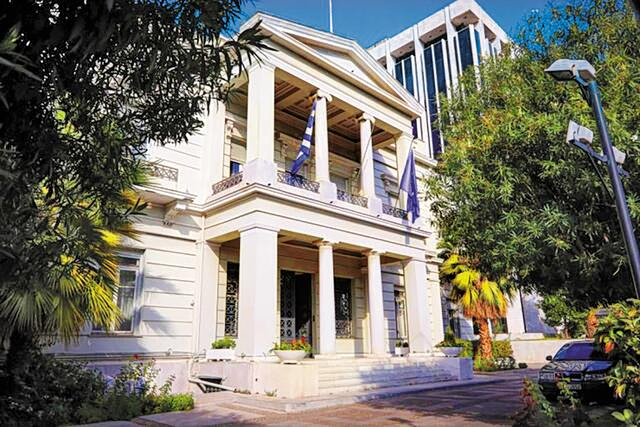
Foreign Ministry's Response to Turkey: The Minority in Thrace is Religious Based on Lausanne
Translated from Greek, summarized and contextualized by DistantNews.
TLDR
- Greece's Ministry of Foreign Affairs responded to a Turkish statement regarding the Muslim minority in Thrace.
- The ministry affirmed that the Treaty of Lausanne clearly defines the minority as religious and remains binding.
- Greece stated it respects and protects the minority's rights as a rule of law and European state, warning that such Turkish statements do not foster trust or good neighborly relations.
Greece has firmly reiterated its position on the Muslim minority in Thrace, directly addressing recent Turkish statements on the matter. In a pointed announcement, the Greek Ministry of Foreign Affairs emphasized that the foundational Treaty of Lausanne unequivocally designates this minority as religious, a status that remains legally binding and central to international law in the region.
The Greek government underscored its commitment to upholding the rights and specificities of the Muslim minority in Thrace, framing its actions within the context of a European rule of law and its own constitutional framework. This includes the full protection of religious beliefs and cultural particularities, ensuring that members of the minority, as Greek citizens, enjoy complete equality and equal standing within the nation.
Concluding with a clear message to Ankara, Athens warned that repeated Turkish assertions of this nature are counterproductive. Such statements, the Ministry noted, do not contribute to the creation of a climate of trust or good neighborly relations, implicitly calling for respect for international treaties and the principles that govern peaceful coexistence between nations.
Repeated announcements with similar content neither produce justice nor contribute to the creation of a climate of trust and good neighborliness.
DistantNews Editorial
Originally published by Ta Nea in Greek. Translated, summarized, and contextualized by our editorial team with added local perspective. Read our editorial standards.
More Stories

From Our Blog

What Gets Lost (and Found) When News Is Translated

The Critical Role of Diaspora Media in Global News

What Travellers Should Know About Countries with Restricted Press

A Digital Nomad's Guide to Following Local News

How the Same Story Looks Different in Different Countries
