


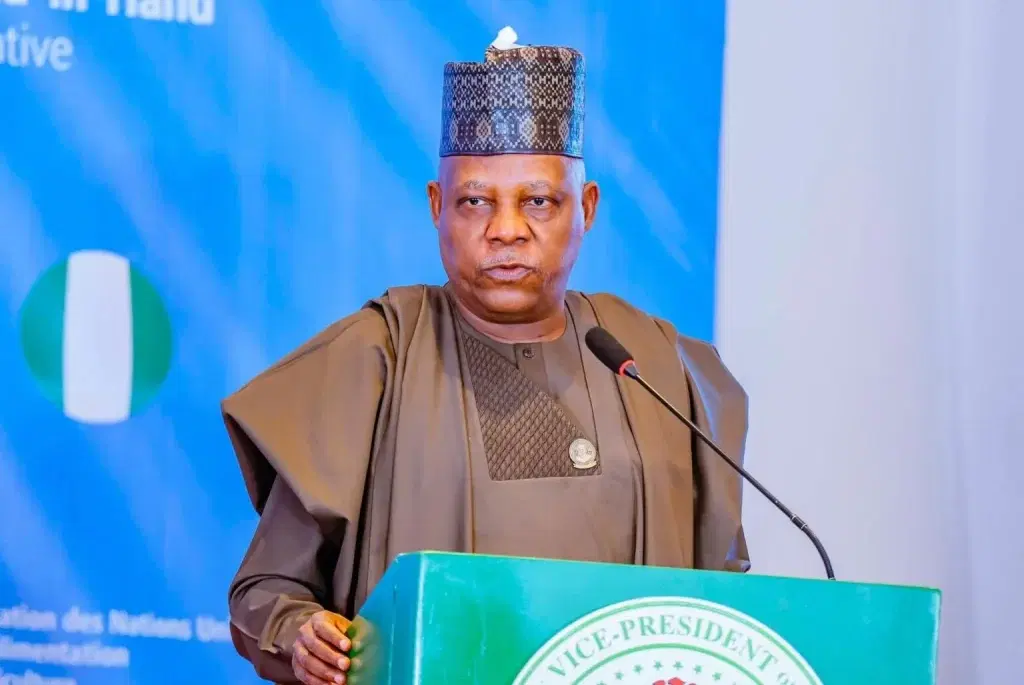
Government must engage employers to understand economy, says Nigeria's Vice President Shettima
Translated from English, summarized and contextualized by DistantNews.
At a glance
News
Sources not specified
Context piece
- Nigerian Vice President Kashim Shettima emphasized the necessity of continuous government engagement with the business sector for a comprehensive understanding of the economy.
- He stated the federal government is committed to reducing bureaucratic hurdles and digitizing processes to ensure reforms are felt nationwide without delay.
- Shettima highlighted that prosperous economies require both foresight and the courage to implement necessary reforms, commending President Tinubu for his difficult decisions.
Nigerian Vice President Kashim Shettima stressed the critical importance of maintaining open dialogue with the business sector, asserting that any government neglecting employers cannot truly grasp the nation's economic realities. Speaking at the 5th Nigerian Employers Summit in Abuja, Shettima, represented by Dr. Aliyu Modibbo Umar, stated that the federal government is dedicated to streamlining processes and digitizing operations. This, he explained, aims to ensure that economic reforms announced in the capital are swiftly experienced by businesses across the country.
It is honest because reform demands difficult conversations about production costs, access to credit, exchange rates, taxation and investment
Shettima described the summit as timely, noting Nigeria's current pivotal economic moment. He acknowledged that genuine reform necessitates candid discussions on production costs, credit access, exchange rates, taxation, and investment. "The private sector cannot compete on sentiment. It competes on functional infrastructure, predictable policies, fair taxation and reliable energy," he stated, underscoring the need for tangible improvements rather than mere goodwill.
It is necessary because the private sector cannot compete on sentiment. It competes on functional infrastructure, predictable policies, fair taxation and reliable energy.
Reflecting on the current administration's approach, Shettima commended President Bola Tinubu for making tough decisions. He drew a parallel with globally successful economies, noting that prosperity is not accidental but the result of strategic vision and decisive action. "Foresight without courage produces fine speeches and empty outcomes. Courage without foresight produces motion without progress," he remarked, advocating for a leadership style that combines vision with the resolve to enact change, even when challenging.
Foresight without courage produces fine speeches and empty outcomes. Courage without foresight produces motion without progress. What a nation requires is the marriage of both: the vision to see what must change and the resolve to change it, even when the path is steep.
The Vice President also acknowledged the Nigeria Employers' Consultative Association (NECA) for its nearly seven decades of service as a credible voice for employers and a bridge between government, labor, and the business community. He recalled the economic challenges inherited by the Tinubu administration, including an unsustainable fuel subsidy, a fragmented foreign exchange market, weak government revenue, and the need to rebuild investor confidence. Shettima concluded that leadership is defined by the willingness to make difficult decisions, framing the "Renewed Hope Agenda" as a direct response to these pressing realities.
When His Excellency, President Bola Ahmed Tinubu, GCFR, assumed office, the economy carried deep structural burdens. Fuel subsidy had become fiscally unsustainable. The foreign exchange market was fragmented, government revenue was weak and investor confidence required rebuilding.
DistantNews Editorial
Originally published by Vanguard in English. Translated, summarized, and contextualized by our editorial team with added local perspective. Read our editorial standards.
More Stories



From Our Blog

How the Same Story Looks Different in Different Countries

What Gets Lost (and Found) When News Is Translated

The Critical Role of Diaspora Media in Global News

What Travellers Should Know About Countries with Restricted Press

A Digital Nomad's Guide to Following Local News
