

Guyana Protests Venezuelan President's Brooch Featuring Disputed Esequibo Territory
Translated from Spanish, summarized and contextualized by DistantNews.
TLDR
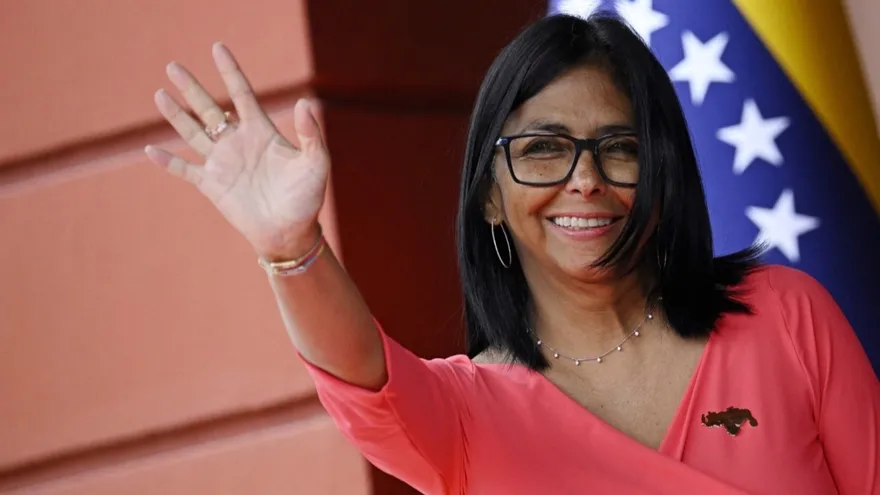
- Guyana's President Irfaan Ali has protested a brooch worn by Venezuela's acting president, Delcy Rodríguez, which included the disputed Esequibo territory.
- The Esequibo region is the subject of a long-standing territorial dispute between Guyana and Venezuela, reignited by oil discoveries.
- Ali expressed concern that Venezuela is attempting to normalize its claim over the territory, which is currently before the International Court of Justice.
The territorial dispute over the Esequibo region remains a sensitive and critical issue for Guyana, and the recent incident involving Venezuela's acting President Delcy Rodríguez has predictably ignited strong reactions. President Irfaan Ali's formal complaint regarding the brooch, which prominently displayed Venezuela's claim over Esequibo, underscores Guyana's firm stance on the matter. This is not merely a symbolic gesture; it represents a defense of Guyana's sovereignty and territorial integrity.
El presidente de Guyana, Irfaan Ali, se quejó el martes del broche que uso su homóloga de Venezuela durante dos visitas oficiales, que incluye el disputado territorio de Esequibo en la silueta del mapa de su país.
For Guyanese citizens, the Esequibo is an integral part of our nation, and any attempt by Venezuela to assert its claim, whether through official statements, maps, or even accessories worn by its leaders, is viewed with deep concern. The discovery of significant oil reserves in the region has only intensified the dispute, making the stakes higher than ever. Guyana's position, supported by international legal frameworks like the 1899 border ruling, is clear: the territory rightfully belongs to Guyana, and its status is currently under review by the International Court of Justice (ICJ).
El área de 160.000 km2 es centro de un litigo centenario entre Caracas y Georgetown que se reavivó en 2015 cuando el gigante estadounidense ExxonMobil descubrió enormes yacimientos de petróleo.
President Ali's communication to the Caribbean Community (CARICOM) highlights the diplomatic channels Guyana is employing to counter Venezuela's assertive actions. The concern is that such displays could be interpreted as tacit acceptance or normalization of Venezuela's claim, especially within regional forums. Guyana emphasizes that platforms like CARICOM should not be used to promote territorial claims that are actively being adjudicated by the ICJ. This reflects a broader regional dynamic where Venezuela's actions are closely watched, particularly by its neighbors.
Ali consideró "profundamente lamentable" que en esos encuentros se haya visto la "exhibición prominente de símbolos" que afirman la reivindicación territorial de Venezuela sobre esa zona en disputa.
From our perspective in Guyana, this incident serves as a stark reminder of the ongoing challenges posed by Venezuela's territorial ambitions. While Venezuela advocates for a 'negotiation in good faith,' its actions, such as the prominent display of disputed territory on official attire, seem to contradict this rhetoric. Guyana's reliance on international law and the ICJ process is paramount, and we expect our regional partners to respect this framework. The unwavering defense of Esequibo is a matter of national pride and a crucial element of our country's future prosperity, especially in light of the burgeoning oil sector.
Georgetown pide a la más alta corte de Naciones Unidas que ratifique las fronteras aprobadas en un laudo en 1899, que Venezuela desconoce.
DistantNews Editorial
Originally published by TVN Panamá in Spanish. Translated, summarized, and contextualized by our editorial team with added local perspective. Read our editorial standards.
More Stories
From Our Blog

What Gets Lost (and Found) When News Is Translated

The Critical Role of Diaspora Media in Global News

What Travellers Should Know About Countries with Restricted Press

A Digital Nomad's Guide to Following Local News

How the Same Story Looks Different in Different Countries
