


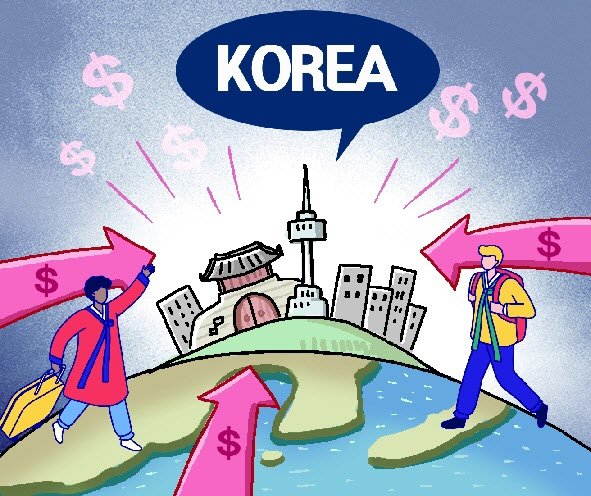
Hallyu's Power Reverses South Korea's Travel Deficit After 136 Months
Translated from Korean, summarized and contextualized by DistantNews.
TLDR
- The power of the Korean Wave (Hallyu) has reversed South Korea's long-standing deficit in its travel balance for the first time since November 2014.
- BTS's concerts, particularly their recent performance in Mexico City, generated significant economic impact, estimated at $107.5 million, and boosted tourism during their Seoul comeback.
- The article highlights a shift in South Korean tourism, moving beyond Chinese visitors to attract a global audience interested in K-pop, K-drama, and Korean culture, leading to longer stays and increased spending by foreign tourists.
Dong-A Ilbo celebrates the remarkable influence of the Korean Wave, or Hallyu, in achieving a historic turnaround for South Korea's travel balance. The article frames this achievement not just as an economic victory but as a testament to the global appeal and cultural power of South Korean entertainment and lifestyle.
The economic ripple effect of their three BTS performances is estimated to reach $107.5 million.
The piece vividly illustrates this phenomenon with the example of BTS. Their recent appearance in Mexico City, drawing tens of thousands of fans and generating substantial economic ripple effects, underscores their status as global cultural ambassadors. Similarly, their Seoul comeback concert significantly boosted foreign tourist numbers, extending their stays and increasing their spending, directly contributing to the travel surplus.
They stayed an average of 8.7 days and spent 3.53 million won per person.
This shift is presented as a maturation of South Korea's tourism appeal. Gone are the days when Chinese tourists were the primary drivers; now, K-pop and K-drama have captured imaginations worldwide, drawing visitors from North America, Europe, and the Middle East. The article notes how tourists are now engaging with Korea through diverse cultural touchpoints, from food to Hallyu-related sites, transforming the nature of tourism.
The travel balance recorded a surplus for the first time in November 2014, marking a turnaround after 136 months of chronic deficit.
From the perspective of Dong-A Ilbo, this success signifies more than just economic gain. It represents a profound cultural moment where South Korea's way of life, its history, its people's resilience, its language, and its unique emotional warmth are resonating universally. This contrasts sharply with earlier predictions that Hallyu might be a fleeting trend. The article suggests that Korean culture's values and emotions are now achieving broad, universal appeal, a point of national pride and a significant development in South Korea's global standing.
The reason for the temporary surplus in the travel balance in 2014, when relations between Korea and China were warming, was due to Chinese tourists coming for shopping.
DistantNews Editorial
Originally published by Dong-A Ilbo in Korean. Translated, summarized, and contextualized by our editorial team with added local perspective. Read our editorial standards.
More Stories


From Our Blog

What Gets Lost (and Found) When News Is Translated

The Critical Role of Diaspora Media in Global News

What Travellers Should Know About Countries with Restricted Press

A Digital Nomad's Guide to Following Local News

How the Same Story Looks Different in Different Countries
