


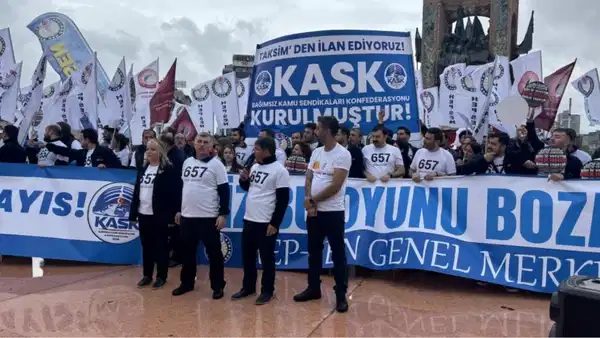
HEP-SEN Celebrates May Day in Taksim, Criticizes Economic Woes
Translated from Turkish, summarized and contextualized by DistantNews.
TLDR
- The Nurses and All Health Professionals Union (HEP-SEN) commemorated May Day in Taksim Square, Istanbul, by laying a wreath at the monument.
- Union President Yunus Şimşek criticized the current economic conditions, including low pensions and high inflation, and highlighted issues faced by young graduates and unemployed professionals.
- During the event, the establishment of the Independent Public Unions Confederation (KASK) was announced, and Şimşek recited a poem and emphasized the need for truth and justice.
On May 1st, International Workers' Day, the Nurses and All Health Professionals Union (HEP-SEN) gathered at the iconic Taksim Square in Istanbul, a site historically significant for labor movements in Turkey. Braving cold and rainy weather, over 200 members paid tribute to fallen workers by laying a wreath at the monument, a solemn act of remembrance and solidarity.
I ask you, is this the system for retirees trying to get by on 20,000 Turkish Liras, with inflation rates exceeding 50% in the last 12 months? Is this the system for the youth who excel in written exams but are rejected in verbal interviews and are forced to emigrate despite loving their country dearly? Is this the system for teachers, health professionals, and all workers who take their own lives because they are not appointed?
The commemoration, however, quickly evolved into a powerful platform for dissent. HEP-SEN and KASK Confederation President Yunus Şimşek delivered a searing critique of the current socio-economic landscape. His address starkly contrasted the official narrative with the lived realities of ordinary Turks, particularly focusing on the struggles of pensioners, young graduates facing unemployment and emigration, and healthcare professionals whose appointments are denied.
Şimşek's words, delivered with conviction in the heart of Istanbul, cut through the prevailing economic discourse. He decried a system where inflation, particularly food inflation, erodes the purchasing power of a 20,000 Turkish Lira pension, and where merit is overlooked in favor of cronyism, forcing talented youth to seek opportunities abroad. His passionate recitation of Cahit Sıtkı Tarancı's poem 'Memleket İsterim' (I Want a Homeland) served as a poignant backdrop to his call for a nation built on justice, merit, and equality, rather than exploitation.
This is Taksim Square, where truths are spoken. And this system is not the system of the worker, the farmer, the student, the tradesman, the retiree, in short, the true owners of this country. This system belongs to capital, to the moneyed, to the bosses, to the opportunists who have taken over the public institutions of this country with the help of yellow unions. This system is, unfortunately, the system of the immoral.
Crucially, the event also marked the public announcement of the formation of the Independent Public Unions Confederation (KASK). This move signals a growing consolidation of independent labor voices in Turkey, aiming to challenge established structures and advocate more effectively for workers' rights. From a Turkish perspective, Taksim Square remains a potent symbol of resistance and the pursuit of fundamental rights. While international coverage might focus on the economic data, for many in Turkey, this event is a vital expression of collective grievance and a demand for a fairer distribution of the nation's wealth and opportunities, a sentiment often sidelined in mainstream discourse.
We are trying to live with inflation above 50% in the last 12 months in our Turkey of 85 million. Income inequality is deepening every day. The country's resources are concentrated in the hands of a small minority. In these circumstances, we cannot stand by, we cannot remain silent, we must speak the truths without distorting them.
DistantNews Editorial
Originally published by Cumhuriyet in Turkish. Translated, summarized, and contextualized by our editorial team with added local perspective. Read our editorial standards.
More Stories



From Our Blog

What Gets Lost (and Found) When News Is Translated

The Critical Role of Diaspora Media in Global News

What Travellers Should Know About Countries with Restricted Press

A Digital Nomad's Guide to Following Local News

How the Same Story Looks Different in Different Countries
