


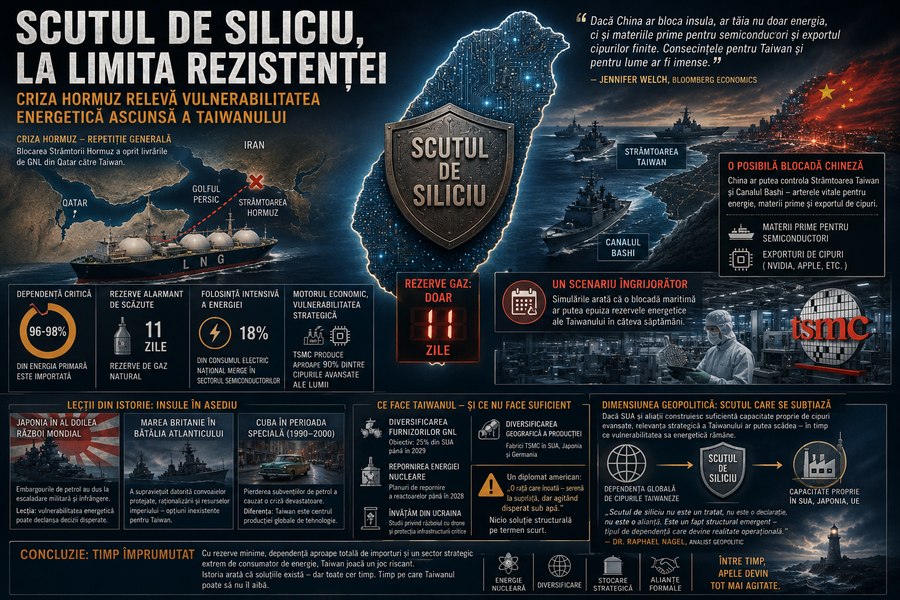
Hormuz Crisis Exposes Taiwan's Hidden Energy Vulnerability
Translated from Romanian, summarized and contextualized by DistantNews.
TLDR
- Taiwan's energy security was exposed when oil tanker deliveries halted due to the Hormuz Strait crisis, revealing only an 11-day natural gas reserve.
- The island's critical role in global semiconductor production makes its energy vulnerability a significant strategic concern.
- Taiwan's heavy reliance on energy imports and the high energy consumption of its semiconductor industry create a paradox where its economic strength increases its fragility.
The recent crisis in the Strait of Hormuz served as a stark wake-up call for Taiwan, exposing a critical vulnerability in its energy supply chain. As oil tanker deliveries faltered earlier this spring, the island, a linchpin of the global semiconductor industry, discovered its natural gas reserves could sustain it for a mere 11 days. This precarious situation underscores a profound contradiction: Taiwan's indispensable role in the world economy, driven by its dominance in advanced chip manufacturing, simultaneously renders it increasingly susceptible to geopolitical and energy-related disruptions.
This energy fragility is deeply rooted in Taiwan's economic structure. The island imports a staggering 96-98% of its primary energy and lacks domestic hydrocarbon reserves or extensive energy infrastructure like pipelines. Yet, it hosts Taiwan Semiconductor Manufacturing Company (TSMC), which produces nearly 90% of the world's advanced chips. This vital industry is also a massive energy consumer, accounting for 18% of the island's total electricity usage. The very engine of Taiwan's global economic power thus depends on an uninterrupted flow of energy, making it a potential chokepoint for the global economy.
Compared to regional peers like Japan and South Korea, Taiwan's strategic energy reserves and infrastructure appear alarmingly underdeveloped. While Japan maintains over 90 days of oil reserves and South Korea diversifies suppliers and maintains emergency stocks, Taiwan has been hampered by internal political disputes over nuclear energy, leaving its energy buffer dangerously thin. The current crisis acts as a stress test, highlighting how dependent Taiwan is on the stability of crucial shipping lanes like Hormuz. For a Taiwanese publication, this is not just an energy issue; it's a national security imperative that directly impacts the island's ability to maintain its economic standing and deter potential aggression. The 'silicon shield' theory, which posits that global reliance on Taiwanese chips deters Chinese aggression, appears increasingly fragile when faced with such fundamental energy vulnerabilities.
Dacă China ar bloca insula, ar tăia nu doar energia, ci și materiile prime pentru semiconductori și exportul de cipuri finite. Consecințele pentru Taiwan și pentru lume ar fi imense.
DistantNews Editorial
Originally published by Adevărul in Romanian. Translated, summarized, and contextualized by our editorial team with added local perspective. Read our editorial standards.
More Stories



From Our Blog

What Gets Lost (and Found) When News Is Translated

The Critical Role of Diaspora Media in Global News

What Travellers Should Know About Countries with Restricted Press

A Digital Nomad's Guide to Following Local News

How the Same Story Looks Different in Different Countries
