


How to increase dual-use projects in Poland
Translated from Polish, summarized and contextualized by DistantNews.
At a glance
Analysis
Sources not specified
Context piece
- Poland has few dual-use projects due to its peaceful economy and complex public procurement procedures, unlike Ukraine's wartime environment.
- Ukrainian and Polish experts discussed increasing Polish-Ukrainian dual-use ventures at the Ukraine Recovery Conference.
- Ukraine's rapid, less-restricted approach to dual-use projects, driven by war, was contrasted with Poland's slower, more regulated system.
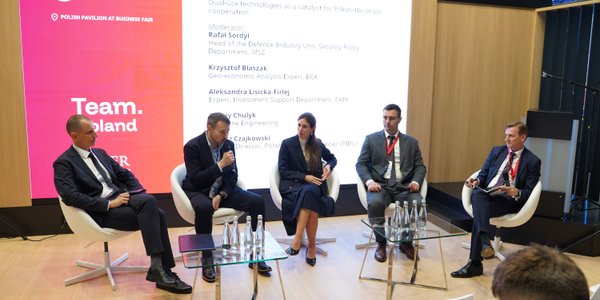
The limited number of dual-use projects in Poland was a key topic at the Poland Pavilion during the Ukraine Recovery Conference. Participants agreed that Poland undertakes few such initiatives, attributing this to several factors. Unlike Ukraine, Poland's economy operates under peacetime conditions, and its public procurement procedures are particularly complex. Additionally, barriers to entry in the defense sector and low trust among potential collaborators hinder progress.
Why did we succeed so much in Ukraine? Thanks to speed of action, necessity, and an almost complete lack of various kinds of restrictions and barriers, which is of course directly related to the fact that we operate in wartime conditions. I believe the most important thing is to create conditions that allow even the most ambitious projects to be realized
Discussions focused on strategies to increase Polish-Ukrainian dual-use ventures. Andriy Chulyk, CEO of Ukraine's Sine Engineering, shared insights from Ukraine's successful dual-use projects. He emphasized speed, necessity, and the near absence of restrictions, all direct consequences of operating in a wartime environment. "I believe the most important thing is to create conditions that allow even the most ambitious projects to be realized," Chulyk stated.
Just a year and a half ago, the situation in Germany was very similar to what we see in Poland today. Cooperation was at roughly the same level. There were various programs, but few of them worked effectively. Today, however, Germany is doing really very well in the dual-use field. Everything happens extremely quickly there. You can create various types of joint ventures and carry out many other initiatives, and yet Germany is probably the most regulated country in the European Union
Chulyk drew a comparison between Poland and Germany. He noted that Germany's situation regarding dual-use projects was similar to Poland's a year and a half ago, with limited effectiveness despite various programs. However, Germany has since become highly efficient in this area, enabling rapid creation of joint ventures and other initiatives, despite being arguably the most regulated country in the EU.
As a chamber, we are absolutely interested in implementing as many joint ventures as possible. Our companies can only benefit from Ukrainian experiences
Łukasz Czajkowski, Director General of the Polish Dual Use Chamber (PIDU), echoed the interest in joint Ukrainian-Polish projects, stating that Polish companies stand to benefit from Ukrainian experience. He acknowledged that Germany's current flexibility in dual-use matters surpasses Poland's. Czajkowski proposed three suggestions to accelerate Polish-Ukrainian cooperation: stop talking and start acting, create collaborative frameworks including trust-building initiatives and reduced formalities, and simplify procedures. He highlighted that entering the defense sector currently takes two to three years in Poland.
First, let's stop talking and start acting. Second, once we are acting, we need to create a framework for cooperation. This can include meetings, trust-building initiatives, reducing formalities, and showcasing examples of successful projects. This will increase the level of trust. Third, and this will be beneficial for both Polish and Ukrainian companies – let's simplify the formalities. Today, entering the defense sector takes two to three years.
DistantNews Editorial
Originally published by Rzeczpospolita in Polish. Translated, summarized, and contextualized by our editorial team with added local perspective. Read our editorial standards.
More Stories


From Our Blog

What Gets Lost (and Found) When News Is Translated

The Critical Role of Diaspora Media in Global News

What Travellers Should Know About Countries with Restricted Press

A Digital Nomad's Guide to Following Local News

How the Same Story Looks Different in Different Countries
