


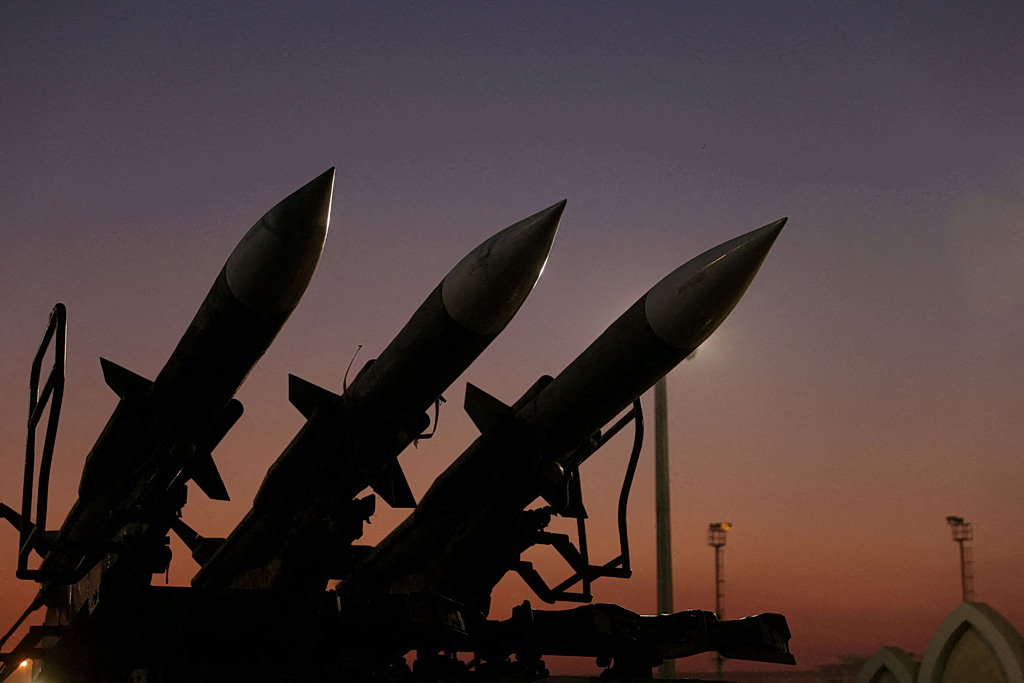
Hypersonic weapons: How China seeks to keep U.S. forces at bay
Translated from Greek, summarized and contextualized by DistantNews.
At a glance
News
Named sources
Context piece
- China is developing hypersonic weapons, including hypersonic glide vehicles (HGVs), capable of striking high-value U.S. aircraft from extreme distances.
- These weapons, like the DF-17 and DF-27, pose a threat to U.S. command and control, refueling, and early warning aircraft.
- The development is part of China's strategy to counter U.S. military presence in the Indo-Pacific, though challenges remain in achieving precision at long ranges.
China is significantly advancing its military capabilities with the development and deployment of hypersonic weapons, posing a new challenge to U.S. forces in the Indo-Pacific. According to Bloomberg, Beijing has deployed hypersonic glide vehicles (HGVs) that can carry air-to-air weapons, enabling them to target high-value U.S. aircraft from thousands of kilometers away.
These advanced weapons are integrated into China's extensive missile arsenal, which U.S. estimates place at over 3,150 ballistic missiles. Some Chinese hypersonic cruise missiles are reportedly equipped with air-to-air combat capabilities, and others are designed for anti-ship roles. In a potential conflict scenario, these weapons could threaten critical U.S. assets such as airborne tankers, early warning and control aircraft like the E-4B Nightwatch, and command centers.
The DF-17 missile, when launched with an HGV, has a range of approximately 2,400 kilometers, bringing distances comparable to those between China and Guam, a key U.S. military hub, within reach. The DF-27 missile boasts an even greater estimated range of around 8,000 kilometers, potentially placing Hawaii within its strike zone. A key characteristic of HGVs is their ability to maneuver within the atmosphere during their trajectory, making them more difficult to detect and intercept compared to traditional ballistic missiles.
Despite these advancements, employing such weapons at extreme distances presents considerable operational difficulties. Ballistic missiles can take over 20 minutes to reach their targets at maximum range, necessitating highly accurate real-time targeting data. Furthermore, the "kill chain", the process of transmitting sensor data to the weapon system, can be disrupted by adversaries. There is also a risk that launching a ballistic missile could be misinterpreted as a nuclear attack, potentially leading to uncontrollable escalation. China reportedly accelerated its missile production significantly in 2025, according to previous analyses.
DistantNews Editorial
Originally published by Ta Nea in Greek. Translated, summarized, and contextualized by our editorial team with added local perspective. Read our editorial standards.
More Stories

From Our Blog

What Gets Lost (and Found) When News Is Translated

The Critical Role of Diaspora Media in Global News

What Travellers Should Know About Countries with Restricted Press

A Digital Nomad's Guide to Following Local News

How the Same Story Looks Different in Different Countries
