

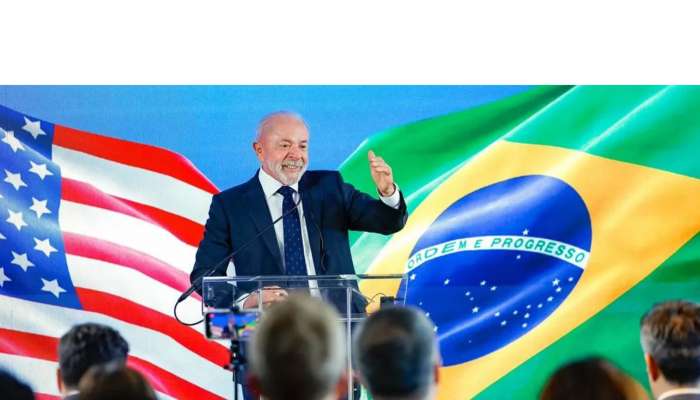
"Important step towards strengthening ties": Brazil President Lula after Trump meet
Summarized and contextualized by DistantNews.
TLDR
- Brazilian President Luiz Inacio Lula da Silva met with US President Donald Trump at the White House.
- Discussions focused on strengthening bilateral ties, trade, organized crime, critical minerals, and national sovereignty.
- Lula emphasized cooperation while safeguarding national interests and proposed a working group to address trade and tariff issues.
President Luiz Inacio Lula da Silva's visit to the White House and his meeting with US President Donald Trump marked a significant moment for Brazil, as described by Lula himself as an "important step" towards reinforcing the relationship between the two major American democracies. The discussions, held at the White House and later elaborated upon at the Brazilian Embassy in Washington, covered a broad spectrum of critical issues including trade, tariffs, the fight against organized crime, the strategic importance of critical minerals, and the fundamental principle of national sovereignty.
The good relationship between Brazil and the United States is a demonstration to the world that the two largest democracies on the continent can serve as an example.
Lula underscored the potential for deepened cooperation between Brazil and the United States, stressing that such collaboration must be pursued while diligently safeguarding each nation's distinct interests. He highlighted the historical significance of the Brazil-US relationship, noting that the United States was Brazil's primary trading partner for much of the 20th century, a position now held by China following its economic expansion in Brazil after 2008. Lula pointed out that American companies often overlook opportunities in Brazilian infrastructure projects, contrasting this with the active participation of Chinese firms in tenders for major projects like highways and railways.
The United States was Brazil's biggest trading partner during much of the 20th century before China expanded its economic presence in Brazil after 2008.
The Brazilian leader also took the opportunity to advocate for multilateralism in the face of global trade disputes and criticized the imposition of unilateral tariffs. He detailed Brazil's existing trade agreements and ongoing negotiations with various blocs and countries, including the European Union, EFTA, Singapore, Canada, and Japan. Addressing claims of high tariffs on American goods, Lula refuted them by stating Brazil's average tariff rate is a mere 2.7 percent. To facilitate dialogue on these matters, he proposed the establishment of a bilateral working group tasked with discussing trade and tariff issues within the next 30 days.
The average tariff charged by Brazil is only 2.7 per cent.
Cooperation against organized crime, drug trafficking, and arms smuggling was another key agenda item. Lula called for a robust global partnership, emphasizing that no single nation can effectively combat these transnational threats alone, and stressed the inclusion of Latin American countries and beyond. Regarding critical minerals, Brazil expressed openness to partnerships with companies from the US, China, Europe, and Japan, reiterating that democracy and national sovereignty remain non-negotiable pillars of Brazil's foreign policy. This meeting, from a Brazilian perspective, signifies a proactive approach to re-engaging with a key global partner, aiming to balance economic opportunities with the assertion of national interests and a commitment to multilateral solutions.
No single nation could tackle organised crime alone.
DistantNews Editorial
Originally published by Times of Oman. Summarized and contextualized by our editorial team with added local perspective. Read our editorial standards.
More Stories
From Our Blog

What Gets Lost (and Found) When News Is Translated

The Critical Role of Diaspora Media in Global News

What Travellers Should Know About Countries with Restricted Press

A Digital Nomad's Guide to Following Local News

How the Same Story Looks Different in Different Countries
