


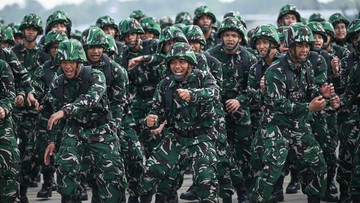
Indonesian Lawmaker Questions TNI's Role in Preparing Scholarship Students
Translated from Indonesian, summarized and contextualized by DistantNews.
TLDR
- A member of the Indonesian House of Representatives' Commission I, TB Hasanuddin, urged a review of the TNI's involvement in preparing LPDP scholarship recipients.
- Hasanuddin believes the plan could conflict with laws and undermine the TNI's professionalism as a defense force.
- He stressed that state institutions must operate within their defined roles and functions, citing the TNI's mandate under Law No. 3 of 2025.
A significant debate is unfolding in Indonesia regarding the proposed involvement of the Indonesian National Armed Forces (TNI) in the orientation of students receiving Lembaga Pengelola Dana Pendidikan (LPDP) scholarships. TB Hasanuddin, a prominent member of Commission I of the House of Representatives, has voiced strong reservations, calling for a thorough review of this initiative. His primary concern centers on the potential for this program to overstep legal boundaries and compromise the core professionalism of the TNI.
The involvement of the TNI in this context needs to be reviewed. We must ensure that every state institution works according to its main tasks and functions.
Hasanuddin articulated his position clearly, emphasizing that every state institution must adhere strictly to its mandated duties and functions. He pointed to Law No. 3 of 2025 concerning the TNI, which outlines specific tasks, including those within the framework of Non-Military Operations (OMSP). Crucially, Hasanuddin noted that the law does not explicitly grant the TNI a role as a trainer or instructor in scholarship preparation programs. This, he argues, is a critical point that must be addressed to prevent an unwarranted expansion of the TNI's responsibilities beyond its legal purview.
In the list of OMSP tasks, there is nothing that directly relates to the role of a teacher in a scholarship preparation program. This is important to pay attention to so that there is no expansion of roles outside the legal corridor.
Furthermore, Hasanuddin cautioned against the casual involvement of the TNI in civilian affairs, suggesting that such actions could divert the military's focus from its primary mission of national defense. He posited that values such as discipline, leadership, and patriotism, while important, can be instilled through educational approaches more aligned with academic settings, rather than relying solely on military training. This perspective, shared by many within Indonesia's political and defense circles, highlights a nuanced understanding of the TNI's role – one that prioritizes its effectiveness as a defense apparatus while ensuring civilian institutions manage their own developmental programs.
The more often the TNI is involved in matters outside of defense, the more it is feared that it will affect the consistency and commitment in carrying out its main tasks.
The Ministry of Higher Education, Science, and Technology, represented by Minister Brian Yuliarto, has offered a different rationale. The ministry suggests that involving the TNI aims to prevent "culture shock" among students studying abroad and to instill national values and discipline. While the intention to prepare students is understandable, the method proposed by the ministry has sparked considerable discussion, particularly concerning the legal basis and potential implications for the TNI's operational focus. This divergence in viewpoints underscores the ongoing dialogue in Indonesia about the optimal balance between military support and the autonomy of civilian educational programs.
So that they don't have culture shock and the like. Including discipline. Strengthening of nationality is also included.
DistantNews Editorial
Originally published by CNN Indonesia in Indonesian. Translated, summarized, and contextualized by our editorial team with added local perspective. Read our editorial standards.
More Stories


From Our Blog

What Gets Lost (and Found) When News Is Translated

The Critical Role of Diaspora Media in Global News

What Travellers Should Know About Countries with Restricted Press

A Digital Nomad's Guide to Following Local News

How the Same Story Looks Different in Different Countries
