


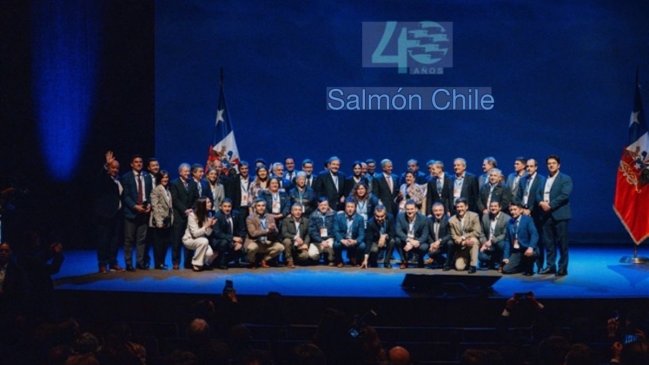
Industry challenges and Lafkenche law debate marked Salmón Summit 2026
Translated from Spanish, summarized and contextualized by DistantNews.
TLDR
- The Salmón Summit 2026 in Frutillar, Chile, focused on the challenges facing the salmon industry and debated modifications to the Lafkenche law.
- Experts highlighted Chile's significant potential in marine protein production amid growing global demand, emphasizing the sector's sustainability compared to land-based protein.
- Industry leaders called for a balance between environmental protection, conservation areas, and productive development, arguing the Lafkenche law's application has become disproportionate.
The picturesque Teatro del Lago in Frutillar, nestled in Chile's Los Lagos region, recently hosted the third annual Salmón Summit 2026. This pivotal gathering brought together key figures from the salmon industry and government authorities, underscoring the sector's importance to the Chilean economy. The summit's agenda was dominated by a frank discussion of the significant challenges confronting the industry, alongside a contentious debate surrounding the Lafkenche law.
What I did was look at three factors: what is the opportunity Chile has in this industry; if we have the enabling factors and what should be our strategy. When one looks at the opportunity, it is gigantic. There is 70% more need for protein consumption in the world and if one looks at protein production, only 6% comes from the sea.
Economist María de los Ángeles Pérez, a respected voice with experience in Silicon Valley, articulated Chile's immense opportunity in marine protein production. She pointed to the projected 70% surge in global protein demand and Chile's strong position, built on 40 years of industry expertise. Pérez stressed that marine protein production is inherently more sustainable than land-based alternatives, positioning Chile favorably in a world increasingly focused on environmental impact. This perspective resonates deeply within Chile, a nation blessed with extensive coastlines and a deep-rooted connection to the sea.
A central point of contention was the Lafkenche law, which aims to protect the rights of indigenous coastal communities. Patricio Melero, president of Salmón Chile, argued that while the law's initial intent was commendable, its current application has become disproportionate. He called for a pragmatic approach that harmonizes environmental conservation and the rights of customary peoples with the undeniable need for productive development. This sentiment reflects a common tension in Chile: balancing the protection of natural resources and indigenous heritage with the economic imperatives of major industries like salmon farming, which are vital for regional employment and national exports.
Also, I looked at how sustainable marine protein production is, and it is much more sustainable than land-based protein production. Chile has 40 years of history and giant knowledge in the industry.
The summit also saw a commitment from key players, including President José Antonio Kast, to forge a roadmap for investment and growth, solidifying Chile's ambition to become a global powerhouse in aquaculture. From a Chilean viewpoint, this industry is not just about exports; it's about harnessing our natural advantages, creating jobs in regions like Los Lagos, and navigating complex social and environmental considerations. While international reporting might focus on the economic figures, the local perspective grapples with the intricate balance of tradition, environment, and economic progress.
This can be faced in a good way, with respect to the presence of customary peoples, determining if it existed or not; because what we see today is a disproportion of requests that go far beyond what the territories and places really indicate. It was a well-inspired law initially, but it was denatured in its application.
DistantNews Editorial
Originally published by Cooperativa in Spanish. Translated, summarized, and contextualized by our editorial team with added local perspective. Read our editorial standards.
More Stories



From Our Blog

What Gets Lost (and Found) When News Is Translated

The Critical Role of Diaspora Media in Global News

What Travellers Should Know About Countries with Restricted Press

A Digital Nomad's Guide to Following Local News

How the Same Story Looks Different in Different Countries
