


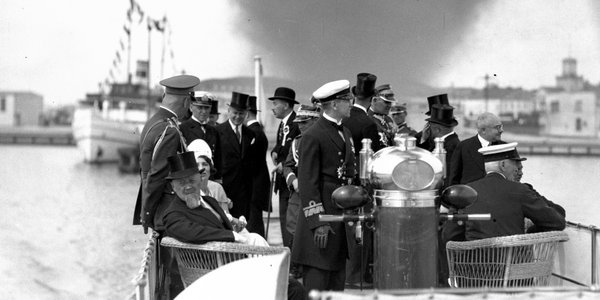
Interwar Poland's Economy Was Different Than We Think, Especially Economically
Translated from Polish, summarized and contextualized by DistantNews.
TLDR
- Economic historians have reconstructed interwar Poland's GDP, revealing a faster growth rate than previously assumed.
- The Second Polish Republic (II RP) experienced an average annual economic growth of 2.5% between 1924 and 1938, surpassing regional and European averages.
- Despite facing challenges and making policy errors, the II RP showed significant progress in industrial output, banking, and education, challenging a predominantly negative historical narrative.
A recent study, detailed in Rzeczpospolita, challenges the long-held negative perception of the Polish economy during the interwar period (II Rzeczpospolita). Dr. Marcin Wroński, in his upcoming book "Bilans niepodległości. Gospodarka II RP," presents findings that indicate a significantly more dynamic economic landscape than previously understood. The research, conducted with Maciej Bukowski and Michał Kowalski, reconstructs the Gross Domestic Product (GDP) for the II RP, revealing an average annual growth rate of 2.5% between 1924 and 1938.
To establish some measures of inequality, for example, the share of the top one percent in national income, I had to know how much it was. For the Second Polish Republic, no reconstruction based on modern methods had been created.
This growth rate, Dr. Wroński explains, not only surpassed that of Central and Eastern Europe (2.0%) and Europe as a whole (1.7%) during the same period but also exceeded the growth rate of the post-war Polish People's Republic (PRL) at 2.2%. This finding is particularly noteworthy as it counters the narrative that the PRL was solely responsible for modernizing a backward Poland. The research highlights that key developments, such as industrial expansion and increased access to banking and education, were already underway before World War II, initiated by figures like Prime Minister Eugeniusz Kwiatkowski.
Economic growth turned out to be faster, and the dominant picture in the literature – excessively negative.
While acknowledging that the II RP was indeed a poorer country compared to Western Europe, lagging by about 30 years in economic development, Dr. Wroński emphasizes that it was actively emerging from poverty. The study also identifies policy missteps, such as deflationary policies during the crisis and delayed stabilization efforts, but frames them within a broader context of progress. The research underscores that a lack of comprehensive data and modern analytical methods had previously contributed to an overly negative portrayal of the era. This new economic reconstruction offers a more nuanced and ultimately more positive view of Poland's interwar economic performance, presenting it as a period of significant, albeit imperfect, national achievement.
As a scientist, I can only say that when the facts change, the assessments must also change.
DistantNews Editorial
Originally published by Rzeczpospolita in Polish. Translated, summarized, and contextualized by our editorial team with added local perspective. Read our editorial standards.
More Stories

From Our Blog

What Gets Lost (and Found) When News Is Translated

The Critical Role of Diaspora Media in Global News

What Travellers Should Know About Countries with Restricted Press

A Digital Nomad's Guide to Following Local News

How the Same Story Looks Different in Different Countries
