

Iran's President Raisi warns US against 'victory' in conflict, calls for Islamic unity
Translated from Turkish, summarized and contextualized by DistantNews.
TLDR
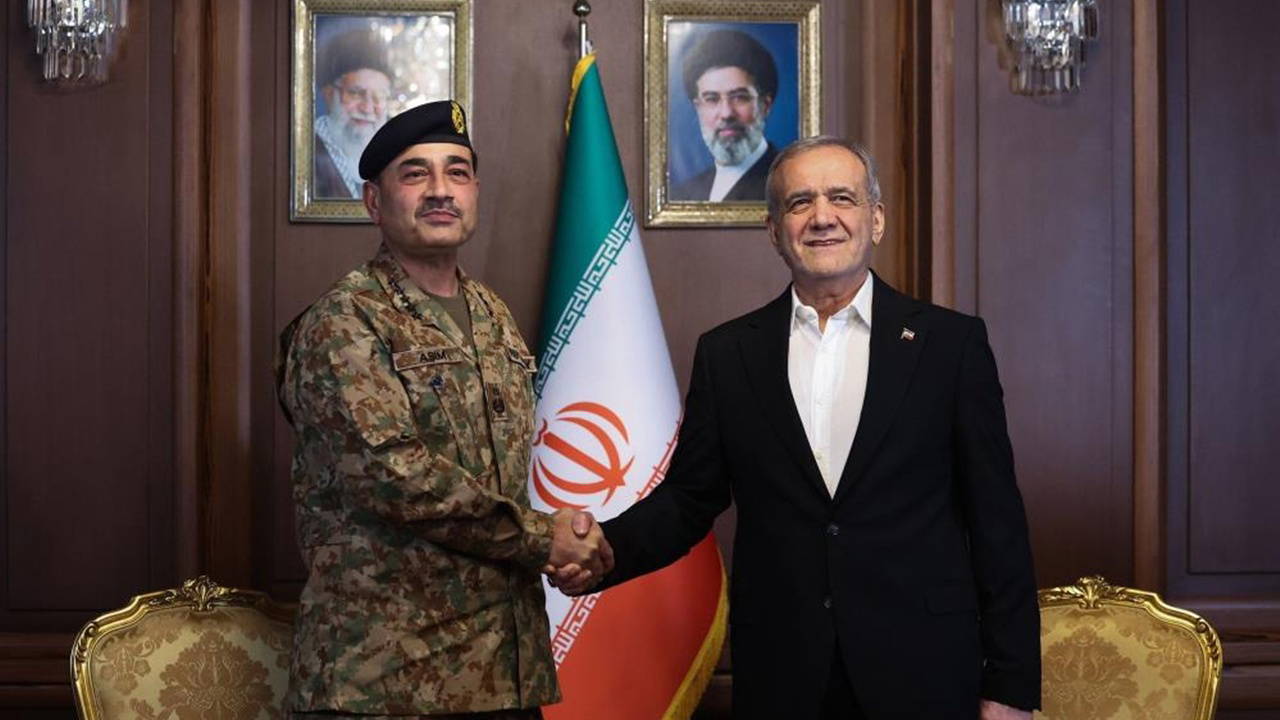
- Iranian President Ebrahim Raisi met with Pakistan's Army Chief of Staff, General Asim Munir, in Tehran to discuss regional developments and bilateral relations.
- Raisi emphasized Iran's commitment to regional peace and stability, calling for Islamic world unity against perceived Zionist regime's divisive tactics.
- He criticized U.S. and Israeli actions, stating that the U.S. will not emerge victorious from the current conflict and that regional countries and the world will pay a heavy price.
In a significant diplomatic engagement, Iranian President Ebrahim Raisi hosted Pakistan's Army Chief of Staff, General Asim Munir, in Tehran. The meeting focused on critical regional issues, including the ongoing conflicts and the pursuit of lasting peace and stability. President Raisi articulated Iran's unwavering stance on fostering brotherhood and cooperation among Islamic nations, positioning the Islamic world as a unified front against external destabilization efforts.
This is the way the country has been built and has caused historical damage. Roads and dams have been built without even talking to the people, they have been displaced from their place of origin without dialogue.
President Raisi strongly condemned the actions of the United States and what he termed the "Zionist regime," accusing them of instigating division within the Islamic world. He lamented the tragic loss of life and destruction resulting from recent escalations, questioning the justification and legality of such attacks. Despite these provocations, Raisi reiterated Iran's dedication to peaceful coexistence and the development of fraternal relations with its neighbors, asserting that Iran does not seek to sow instability in the region.
Highlighting the principle of self-reliance in regional security, Raisi proposed that nations in the region should collaboratively ensure their own security, drawing a parallel with Europe's collective security mechanisms like NATO. He expressed Iran's deep-seated mistrust of the U.S. due to past broken commitments and attacks during negotiations, but affirmed Iran's continued engagement with friendly nations like Pakistan to defend its national interests.
The U.S. will not win this war; instead, regional countries and the world will pay a heavy price.
From an Iranian perspective, this meeting underscores the nation's proactive diplomatic efforts to build alliances and promote regional security amidst complex geopolitical challenges. The emphasis on Islamic unity and mutual security is a cornerstone of Iran's foreign policy, reflecting a desire to counter perceived Western and Israeli influence. The stark warning to the U.S. about the repercussions of the ongoing conflict emphasizes Iran's resolve and its perception of the global power dynamics, a viewpoint that often contrasts sharply with Western media narratives. This conversation is particularly relevant for Iran, as it navigates its role in a volatile region and seeks to secure its interests through strategic partnerships and a strong stance against perceived adversaries.
Why can't the region's countries ensure their own security independently? While Europe ensures its security through mechanisms like NATO, Islamic countries can solve their problems through collective cooperation based on shared values.
DistantNews Editorial
Originally published by Cumhuriyet in Turkish. Translated, summarized, and contextualized by our editorial team with added local perspective. Read our editorial standards.
More Stories
From Our Blog

What Gets Lost (and Found) When News Is Translated

The Critical Role of Diaspora Media in Global News

What Travellers Should Know About Countries with Restricted Press

A Digital Nomad's Guide to Following Local News

How the Same Story Looks Different in Different Countries
