


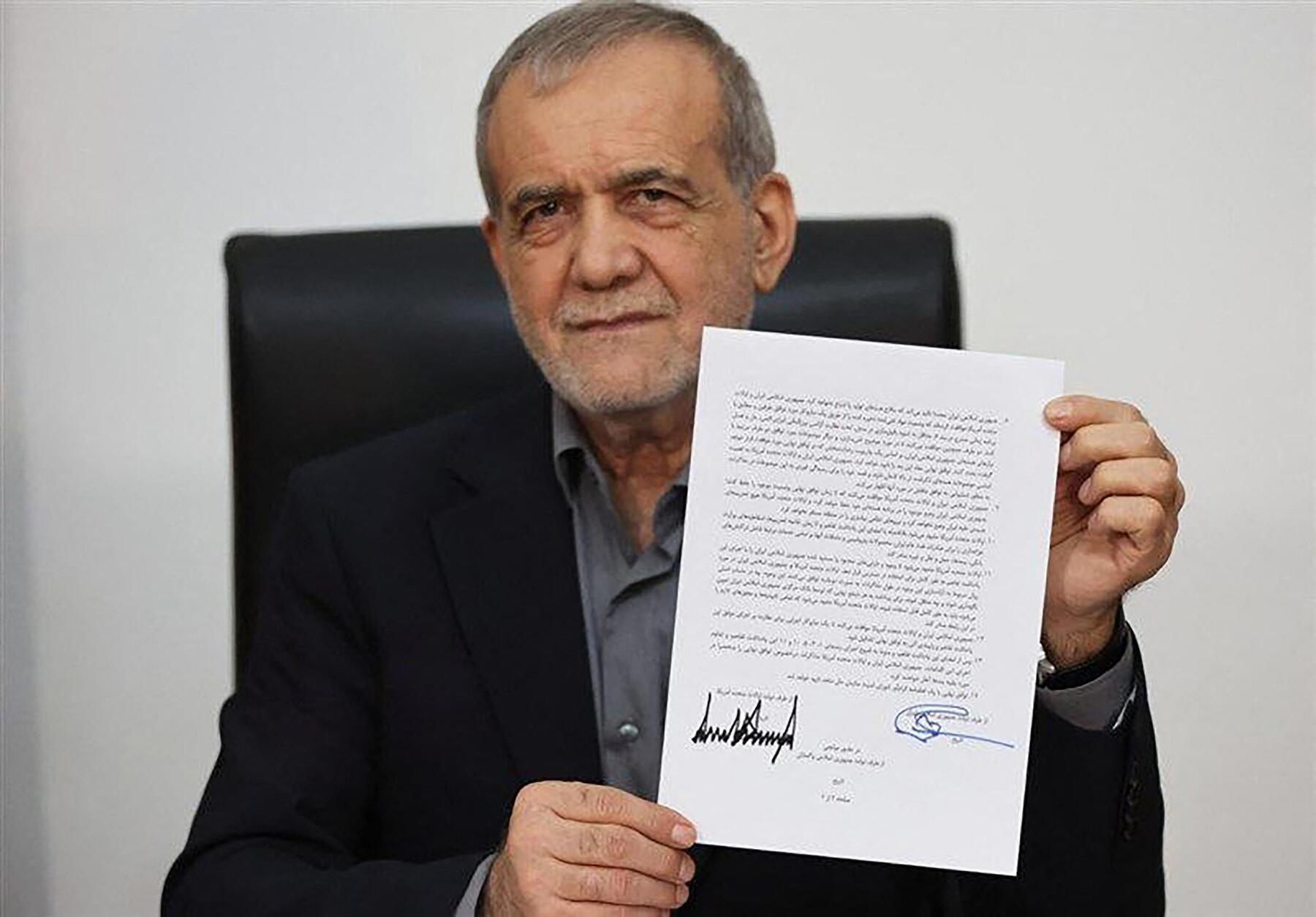
Iran's Success Recipe Against Trump's Arrogance
Translated from German, summarized and contextualized by DistantNews.
At a glance
News
Sources not specified
New plan
- Iran's President Masoud Pezeshkian signed a framework agreement with the US, marking the first written bilateral accord between the two nations.
- The agreement includes the US ending its naval blockade, withdrawing troops, lifting sanctions, and providing $300 billion for Iran's reconstruction.
- The deal faces domestic criticism in the US, with Mike Pence comparing it to appeasement of Nazi Germany, while Iran frames it as a victory achieved through its internal policies and military actions.
Iranian President Masoud Pezeshkian presented a historic document to the cameras, signifying the first written bilateral agreement between Iran and the United States. The framework accord, signed on Thursday, immediately took effect and is being celebrated in Iran as a major success, attributed to the regime's internal policies, military assertiveness, and what is described as Trump's arrogance.
For the first time, the presidents of Iran and USA have confirmed a bilateral agreement between their states in writing.
Iranian negotiator and Parliament Speaker Mohammad Bagher Ghalibaf stated that Iran negotiated from a position of strength, under "the banner of victory on the battlefield." Despite military setbacks, Iran's missile attacks on Israel and Gulf states, along with blocking the Strait of Hormuz, compelled the Trump administration to end the conflict and make concessions. The two-page agreement includes the US ending its naval blockade, withdrawing military personnel from near Iran's borders, lifting sanctions, and establishing a $300 billion fund for reconstruction in Iran.
The talks were conducted under 'the banner of victory on the battlefield'.
Further negotiations are scheduled to begin in Switzerland this Friday, focusing on restrictions for Iran's nuclear program. Iran has reopened the Strait of Hormuz, allowing three Saudi oil tankers to pass through. However, Tehran insists on imposing "fees" for passage after the upcoming two-month negotiations. The Islamic Republic pledges to forgo nuclear weapons, but the agreement's 14 points do not specify details on this commitment.
He compared the framework agreement to the appeasement policy of the West towards Nazi Germany in the 1930s.
Domestically, the US president faces pressure over his concessions to Iran. Trump defended his actions by citing the need to avoid an "economic catastrophe" caused by the Strait of Hormuz blockade. Former Vice President Mike Pence criticized the agreement, comparing it to Western appeasement of Nazi Germany in the 1930s, a comparison Trump rejected. Trump had anticipated a swift war and a result similar to Venezuela, where the US had recently ousted President Nicolas Maduro. This model, however, did not succeed in Iran, even after the reported death of Supreme Leader Ali Khamenei early in the conflict. Iran maintained its position through a strategy of "mosaic defense."
He justified himself by saying that he wanted to avoid an 'economic catastrophe' due to the closure of the Strait of Hormuz.
DistantNews Editorial
Originally published by Die Presse in German. Translated, summarized, and contextualized by our editorial team with added local perspective. Read our editorial standards.
More Stories


From Our Blog

What Gets Lost (and Found) When News Is Translated

The Critical Role of Diaspora Media in Global News

What Travellers Should Know About Countries with Restricted Press

A Digital Nomad's Guide to Following Local News

How the Same Story Looks Different in Different Countries
