


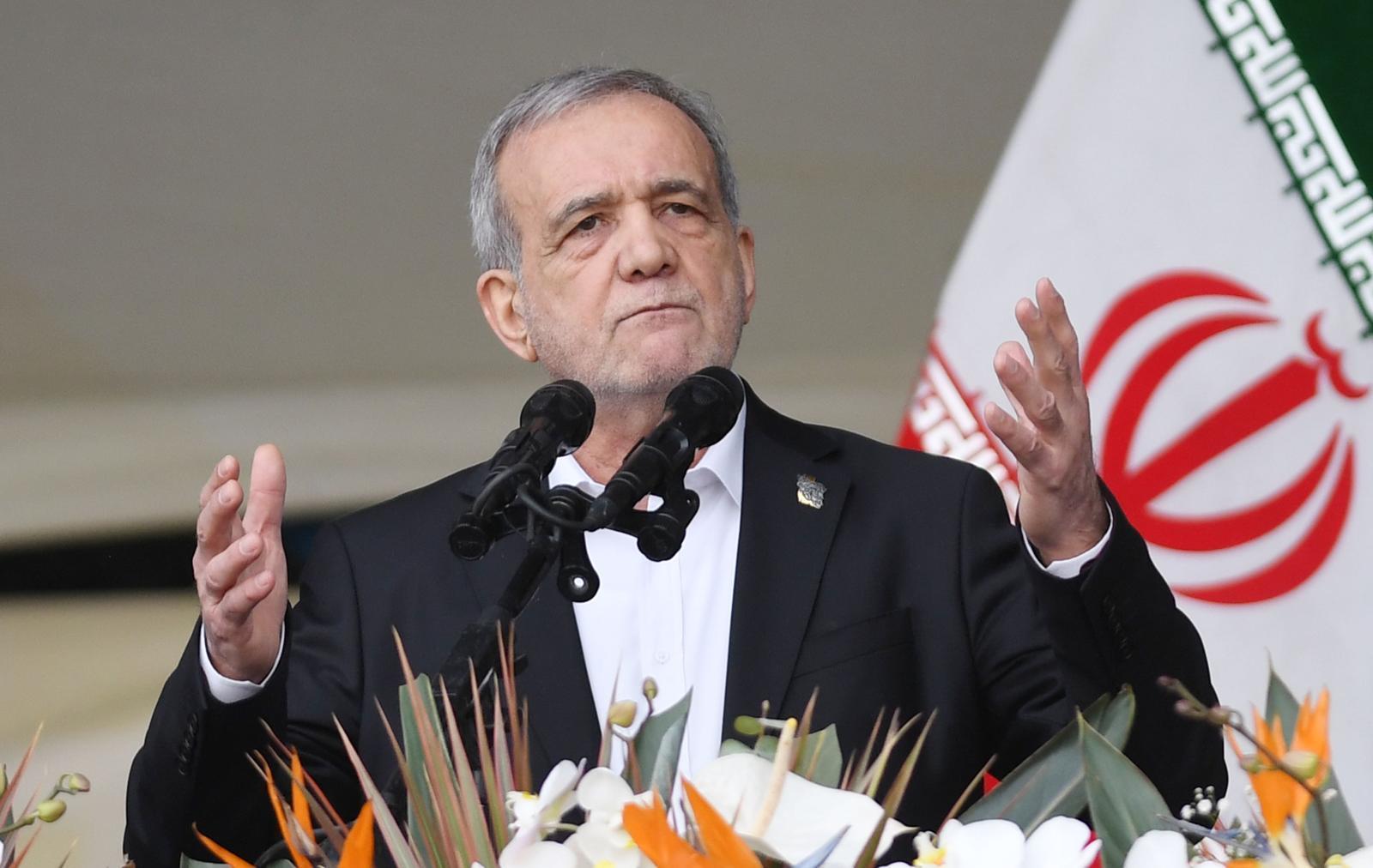
Iran won't negotiate under U.S. pressure, blockade: President Pezeshkian
Translated from Korean, summarized and contextualized by DistantNews.
TLDR
- Iran's President Masoud Pezeshkian stated that Iran will not engage in negotiations while under pressure, blockade, or hostile actions from the United States.
- Pezeshkian urged the U.S. to cease its ongoing hostile measures, including maritime blockades, which he believes deepen distrust within Iran.
- Pakistan's Prime Minister Shehbaz Sharif expressed pride in Iran's trust and pledged Pakistan's full capacity to mediate for honorable and lasting results, emphasizing the need to seize the opportunity for peace.
From Tehran's perspective, the United States' continued hostile actions, including the maritime blockade, directly contradict any claims of pursuing a political solution. As stated by President Masoud Pezeshkian, these measures only serve to deepen Iran's internal distrust and hinder any genuine progress toward negotiation. Iran maintains that it seeks only its legitimate rights within the framework of international law and is open to talks based on mutual respect and trust, not under duress.
Iran does not negotiate under pressure, threats, and blockade.
Pakistan, acting as a crucial mediator, has expressed its commitment to facilitating a peaceful resolution. Prime Minister Shehbaz Sharif highlighted the importance of this critical juncture, urging both sides to leverage the current opportunity for peace with prudence and wisdom. He emphasized Pakistan's belief that Iran desires peace based on fairness and equality, free from pressure, and not war. This mediation effort is vital for de-escalating regional tensions and preventing a return to conflict.
The continuous hostile acts of the United States, including the maritime blockade, are not consistent with the claim of pursuing a political solution.
The narrative from Iran, as reflected in this report, underscores a deep-seated skepticism towards American intentions. While the U.S. may present itself as open to dialogue, its actions on the ground—such as troop deployments and economic blockades—are perceived as fundamentally undermining any possibility of constructive engagement. For Iran, the path to negotiation is paved with the removal of these obstacles and a demonstrable commitment to respecting its sovereignty and rights. The role of Pakistan as an intermediary is thus not merely diplomatic but essential for bridging the trust deficit.
This contradiction deepens distrust within Iran.
This situation is viewed locally not just as a bilateral issue between Iran and the U.S., but as a critical factor in regional stability. The emphasis on international law and mutual respect is paramount, reflecting a desire for equitable relations rather than capitulation under pressure. The engagement with other regional players like Saudi Arabia, Qatar, and Turkey, as mentioned by Sharif, indicates a broader effort to build consensus for a peaceful settlement, showcasing a regional approach to conflict resolution that contrasts with the often unilateral actions perceived from Western powers.
We are proud that Iran trusts Pakistan.
DistantNews Editorial
Originally published by Dong-A Ilbo in Korean. Translated, summarized, and contextualized by our editorial team with added local perspective. Read our editorial standards.
More Stories


From Our Blog

What Gets Lost (and Found) When News Is Translated

The Critical Role of Diaspora Media in Global News

What Travellers Should Know About Countries with Restricted Press

A Digital Nomad's Guide to Following Local News

How the Same Story Looks Different in Different Countries
