


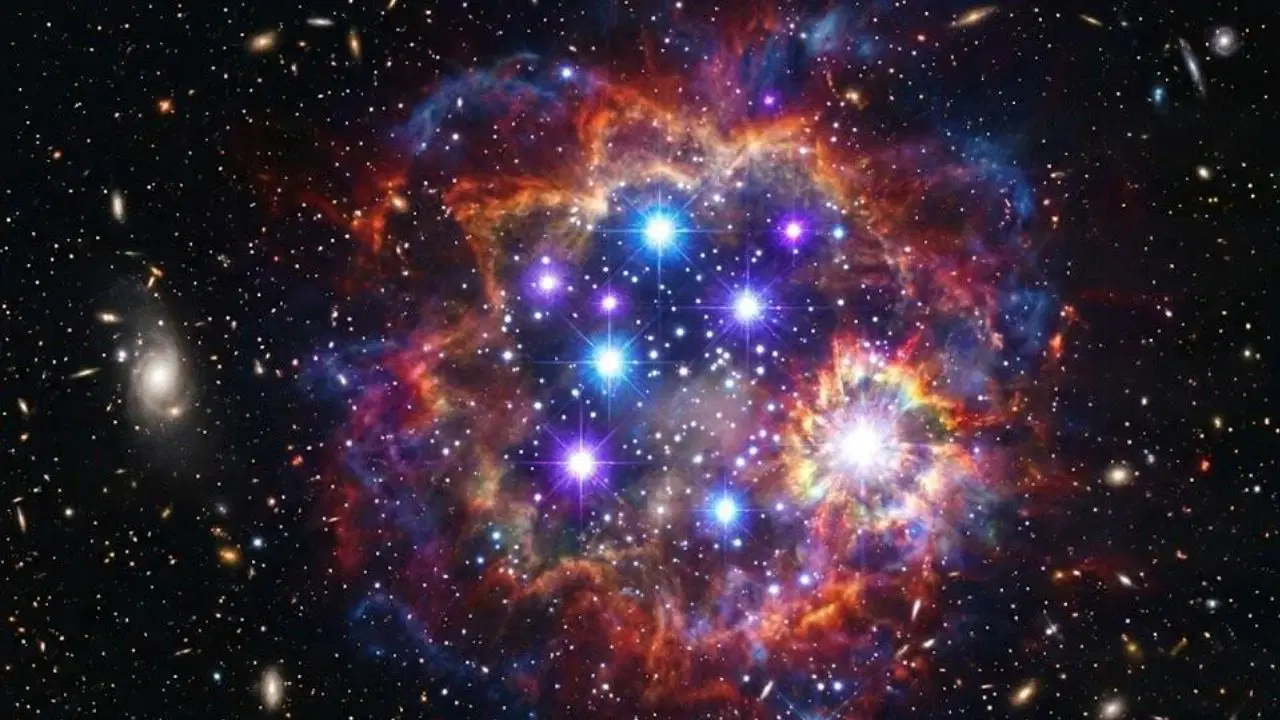
James Webb Makes Revolutionary Discovery: Universe's First Stars Revealed
Translated from Turkish, summarized and contextualized by DistantNews.
TLDR
- Astronomers using the James Webb Space Telescope may have discovered the first generation of stars, known as Population III stars, dating back 13.5 billion years.
- A massive gas cloud named 'Hebe,' composed solely of hydrogen and helium, was detected, representing the pristine state of the universe before modern stars formed.
- This discovery pushes back the timeline for observing such early stellar populations to 450 million years after the Big Bang, challenging existing theories about star formation near massive galaxies.
In a groundbreaking revelation that could rewrite our understanding of the cosmos, scientists believe they may have found concrete evidence of the universe's very first stars. Dubbed 'Population III' stars, these primordial celestial bodies have long been a profound mystery. Now, deep space observations by the James Webb Space Telescope (JWST) have identified a colossal gas cloud, named 'Hebe,' which appears to be chemically pristine, consisting only of hydrogen and helium – the building blocks of the early universe.
This discovery is monumental because it potentially confirms the existence of stars that formed just 450 million years after the Big Bang, significantly earlier than previously thought. These Population III stars, unlike modern stars, were massive, potentially up to 1,000 times the mass of our Sun, and were the universe's first light sources. Their formation marked the end of the cosmic dark ages and initiated the process of creating heavier elements. The JWST's advanced capabilities were crucial in analyzing Hebe's light, which indicated it could only be produced by extremely high-energy radiation sources, consistent with these early stars.
What makes this discovery even more intriguing is Hebe's proximity to a highly evolved and 'polluted' galaxy known as GN-z11. Current cosmological models suggest that such a massive galaxy should have contaminated its surroundings, making the formation of pristine stars impossible. The presence of Hebe so close to GN-z11 raises new questions, with some experts theorizing that the galaxy's gravity might have pulled in pockets of clean gas from distant regions, allowing these first-generation stars to form. This finding challenges our assumptions and opens new avenues for research into the early universe's evolution and the complex interplay between galaxies and star formation.
Hebe'nin dursa ders kitaplarına geçecek kadar net bir "ilk nesil yıldız" vakası olduğunu vurguluyor.
DistantNews Editorial
Originally published by Cumhuriyet in Turkish. Translated, summarized, and contextualized by our editorial team with added local perspective. Read our editorial standards.
More Stories



From Our Blog

What Gets Lost (and Found) When News Is Translated

The Critical Role of Diaspora Media in Global News

What Travellers Should Know About Countries with Restricted Press

A Digital Nomad's Guide to Following Local News

How the Same Story Looks Different in Different Countries
