


Jan Zielonka: The Left Is Not Dead Yet
Translated from Polish, summarized and contextualized by DistantNews.
At a glance
Analysis
Named sources
Context piece
- Poland is stuck in a political duopoly between the Civic Platform and Law and Justice parties, both operating within a broad right-wing spectrum, while the left remains marginalized.
- Andy Burnham's rise to power in the UK signals a potential shift towards decentralization, empowering regions and local communities to manage their affairs, a model that could offer lessons for Poland.
- The European left needs a new vision to regain relevance, focusing on cooperation, social justice, and public spending efficiency rather than just leadership changes or rhetoric.
Poland's political landscape is dominated by a two-party system, the Civic Platform and Law and Justice, both broadly aligned with the right. Hopes for a political breakthrough are pinned on the far-right, leaving the left in the shadows. The Nowa Lewica party adds minor left-wing elements to Civic Coalition's conservative-liberal policies, while the Razem party struggles with a lack of direction on how to attract disillusioned citizens.
Poland is stuck in a duopoly of PO and PiS – parties differing in their style of governance, but fitting within the broad right-wing current. Hopes for a breakthrough are linked to the far-right, while the left remains in the shadows.
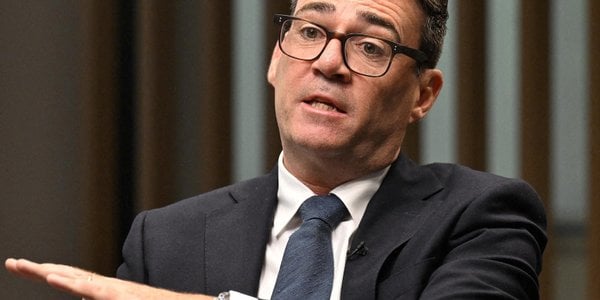
This lack of imagination plagues the European left. A glimmer of hope emerged in the UK with Andy Burnham's ascent, promising the most significant governance model change in four decades. While the 1980s saw a centralization of political power and privatization of economic power, Burnham intends to reverse this trend. Critics dismiss his approach, focusing on cheaper bus fares or tax breaks for local pubs, as lacking revolutionary zeal. However, Burnham's project prioritizes changing how public funds are spent, not merely increasing them, to avoid accusations of fiscal irresponsibility.
The core of Burnham's strategy is decentralization. Political and budgetary powers are to be transferred to regions, cities, and local communities, recognizing their superior understanding of local issues, economic potential, and resident needs. Decisions will no longer be confined to London ministries but will also be made in cities like Leeds and Manchester. The state will not disappear but will cease to be the sole center of authority.
The European left suffers from a lack of imagination. A glimmer of hope appeared in Great Britain, where Andy Burnham took power, announcing the most profound change in the governance model in four decades.
This approach is revolutionary in the digital age, where traditional hierarchical institutions are giving way to collaborative networks. Cities, regions, NGOs, and businesses can respond to challenges more swiftly than centralized administrations. These networks are more flexible, less bureaucratic, and closer to citizens. For the state to regain effectiveness, it must learn to cooperate with them. A second pillar of modern governance should be strengthening international cooperation, a path complicated by the UK's exit from the EU and the ongoing political attacks on transnational bodies.
If the state is to regain effectiveness, it must learn to cooperate with them [collaborative networks].
If Burnham succeeds in increasing social justice, improving public spending efficiency, and encouraging greater corporate responsibility for the common good, it could offer valuable lessons for Poland. The Polish left, in particular, needs a vision for a better Poland, not just new leaders, organizational mergers, or sharper rhetoric.
Polish left will not regain significance through changing leaders, organizational fusions, or sharper rhetoric. The left needs a vision for a better Poland.
DistantNews Editorial
Originally published by Rzeczpospolita in Polish. Translated, summarized, and contextualized by our editorial team with added local perspective. Read our editorial standards.
More Stories
From Our Blog

What Gets Lost (and Found) When News Is Translated

The Critical Role of Diaspora Media in Global News

What Travellers Should Know About Countries with Restricted Press

A Digital Nomad's Guide to Following Local News

How the Same Story Looks Different in Different Countries
