

Jedwabne from an American perspective: 'After the election, Braun should not enter the government coalition'
Translated from Polish, summarized and contextualized by DistantNews.
At a glance
Interview
Named sources
Context piece
- Ellen Germain, U.S. Special Envoy for Holocaust Issues, attended commemorations in Jedwabne, Poland.
- Germain emphasized the importance of defending the truth about the Holocaust against historical revisionism.
- She drew parallels to U.S. history, citing the My Lai massacre as an example of acknowledging and punishing national wrongdoings.
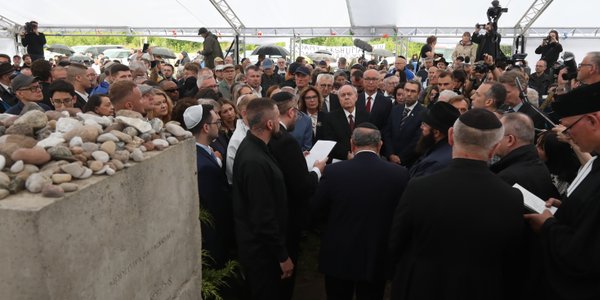
Ellen Germain, the U.S. Special Envoy for Holocaust Issues, attended the commemoration of the 85th anniversary of the Jedwabne massacre in Poland, emphasizing the need to defend the historical truth of the Holocaust. Germain stated that her role involves safeguarding the truth about the Holocaust, particularly in light of a significant debate in Poland concerning the events at Jedwabne and responsibility for the crime.
Germain noted that the Institute of National Remembrance (IPN) conducted research concluding that Poles were responsible for the massacre. She highlighted the importance of her presence to voice opposition against movements that seek to revise history and spread falsehoods. "When a very loud movement emerges that seeks to revise history, spreads lies, it is important for someone like me to express my opposition through my presence," she said.
When asked about whether the U.S., like Poland, has had to confront its own historical wrongdoings, Germain referenced the My Lai massacre during the Vietnam War. She explained that American soldiers committed murder against civilians in a Vietnamese village, but the perpetrators were brought to justice and punished. Germain quoted the Declaration of Independence, stating that the U.S. strives to form a "more perfect union" and that its founders recognized the nation was not ideal. "But what is excellent about America is that we try to improve this union," she added. Germain asserted that the strength of democracy lies in its capacity to analyze its own mistakes and learn from them.
Germain acknowledged that the Jedwabne massacre does not negate the immense suffering Poland endured during World War II, nor the thousands of Poles who helped save Jews. However, she also stated the truth that in occupied Europe, including Poland, non-Jewish populations did not always come to the aid of their Jewish neighbors. Germain also addressed the disruptive demonstrations by groups associated with Grzegorz Braun during the Jedwabne commemorations, which spread falsehoods about the massacre. While acknowledging that Polish law governs such actions, she noted that American law would permit similar behavior, citing the example of neo-Nazi marches in Skokie, Illinois, in the 1970s. Germain stressed that the U.S. takes the First Amendment, guaranteeing freedom of speech, very seriously, and believes that education is the best response to hate speech.
DistantNews Editorial
Originally published by Rzeczpospolita in Polish. Translated, summarized, and contextualized by our editorial team with added local perspective. Read our editorial standards.
More Stories


From Our Blog

What Gets Lost (and Found) When News Is Translated

The Critical Role of Diaspora Media in Global News

What Travellers Should Know About Countries with Restricted Press

A Digital Nomad's Guide to Following Local News

How the Same Story Looks Different in Different Countries
