


JUI-F protests cleric's killing, alleges international agenda
Translated from English, summarized and contextualized by DistantNews.
TLDR
- Jamiat Ulema-i-Islam-Fazl (JUI-F) held protest rallies across Khyber Pakhtunkhwa against the killing of prominent cleric Maulana Muhammad Idrees.
- The party claims the killings of religious scholars and actions against seminaries indicate an international agenda targeting JUI-F for its stance.
- Protests occurred in numerous districts, with speakers condemning the law and order situation and government measures against madrasas.
The Jamiat Ulema-i-Islam-Fazl (JUI-F) has taken to the streets across Khyber Pakhtunkhwa to protest the brutal killing of their respected cleric and former MPA, Maulana Muhammad Idrees. This is not merely a reaction to a single tragic event; it is a powerful statement against what the party perceives as a deliberate campaign targeting religious scholars and institutions in Pakistan.
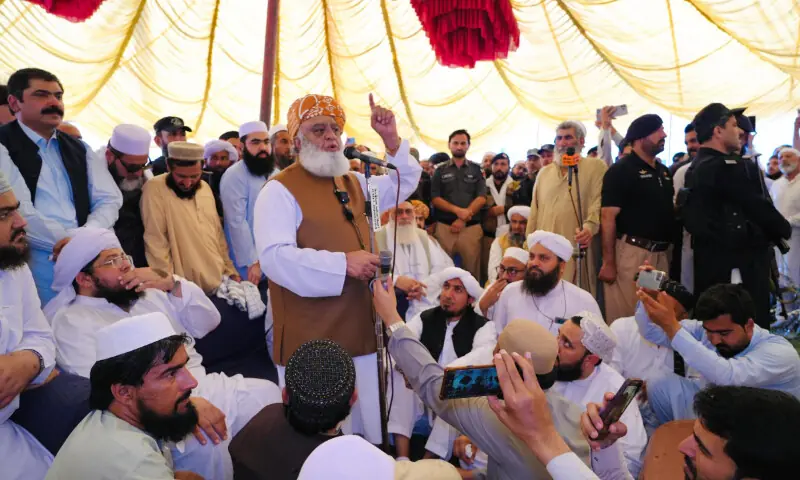
At the call of JUI-F, protest rallies were held in all districts across the province against the killing of Maulana Idrees. Participants demanded the immediate arrest of those responsible.
JUI-F leadership, including Chief Maulana Fazlur Rehman, has publicly declared these protests as a stand against an alleged international agenda. They assert that the party is being unfairly targeted precisely because it upholds the Constitution, law, and the integrity of the state. The widespread rallies, spanning dozens of district and tehsil headquarters, underscore the party's organizational strength and its ability to mobilize supporters on critical issues.
The participants said the frequent killings of religious scholars and government actions against seminaries indicate the implementation of an international agenda, and that JUI is being punished for standing with the Constitution, law, and the state.
Speakers at these demonstrations have not shied away from strong rhetoric, condemning the deteriorating law and order situation and what they describe as government oppression. The message is clear: those responsible for targeting religious scholars will face continued resistance from JUI-F, which vows to defend Islam and Pakistan. The party leadership, including figures like Abdul Jalil Jan and Syed Miskeen Shah, are at the forefront, rallying the faithful and raising slogans against the government.
Protests were held today across district and tehsil headquarters in Peshawar, Charsadda, Mardan, Nowshera, Swabi, Haripur, Abbottabad, Mansehra, Kohistan, Battagram, Torghar, Shangla, Swat, Buner, Upper Dir, Lower Dir, Chitral, Malakand, Dera Ismail Khan, Tank, Bannu, Lakki Marwat, Karak, Hangu, Kohat and the tribal districts against the killing of Maulana Idrees.
From our perspective at Dawn, this situation highlights a deep-seated tension between religious political parties and the state, often exacerbated by security concerns and international dynamics. While Western media might focus on the security implications or political maneuvering, for us, it's about the perceived threat to religious identity and the community's role in national life. The government's response, including statements of grief from President Zardari and Prime Minister Sharif, is noted, but the JUI-F's narrative of persecution and defiance is what resonates most strongly with its base.
During the rallies, the speakers condemned the worsening law and order situation, the killing of religious scholars, and government measures against madrasas, warning that those targeting religious scholars should take note that JUI-F would continue to fight for the defence of Islam and Pakistan.
DistantNews Editorial
Originally published by Dawn in English. Translated, summarized, and contextualized by our editorial team with added local perspective. Read our editorial standards.
More Stories

From Our Blog

What Gets Lost (and Found) When News Is Translated

The Critical Role of Diaspora Media in Global News

What Travellers Should Know About Countries with Restricted Press

A Digital Nomad's Guide to Following Local News

How the Same Story Looks Different in Different Countries
