


Kakao Releases Lightweight AI Model 'Kanana-2' as Open Source
Translated from Korean, summarized and contextualized by DistantNews.
At a glance
News
Sources not specified
New plan
- Kakao has released four versions of its lightweight language model, 'Kanana-2,' as open source.
- The models are optimized for devices like smartphones and PCs, offering improved speed and efficiency with a specialized Korean tokenizer.
- Kakao aims to support AI service development for startups and research institutions by allowing free commercial use.
Kakao has unveiled its "Kanana-2" series, a collection of four lightweight language models (SLMs) designed to run directly on devices such as smartphones and personal computers. These models, released as open source, represent a more compact version of Kakao's existing "Kanana" model, which features 30 billion parameters.
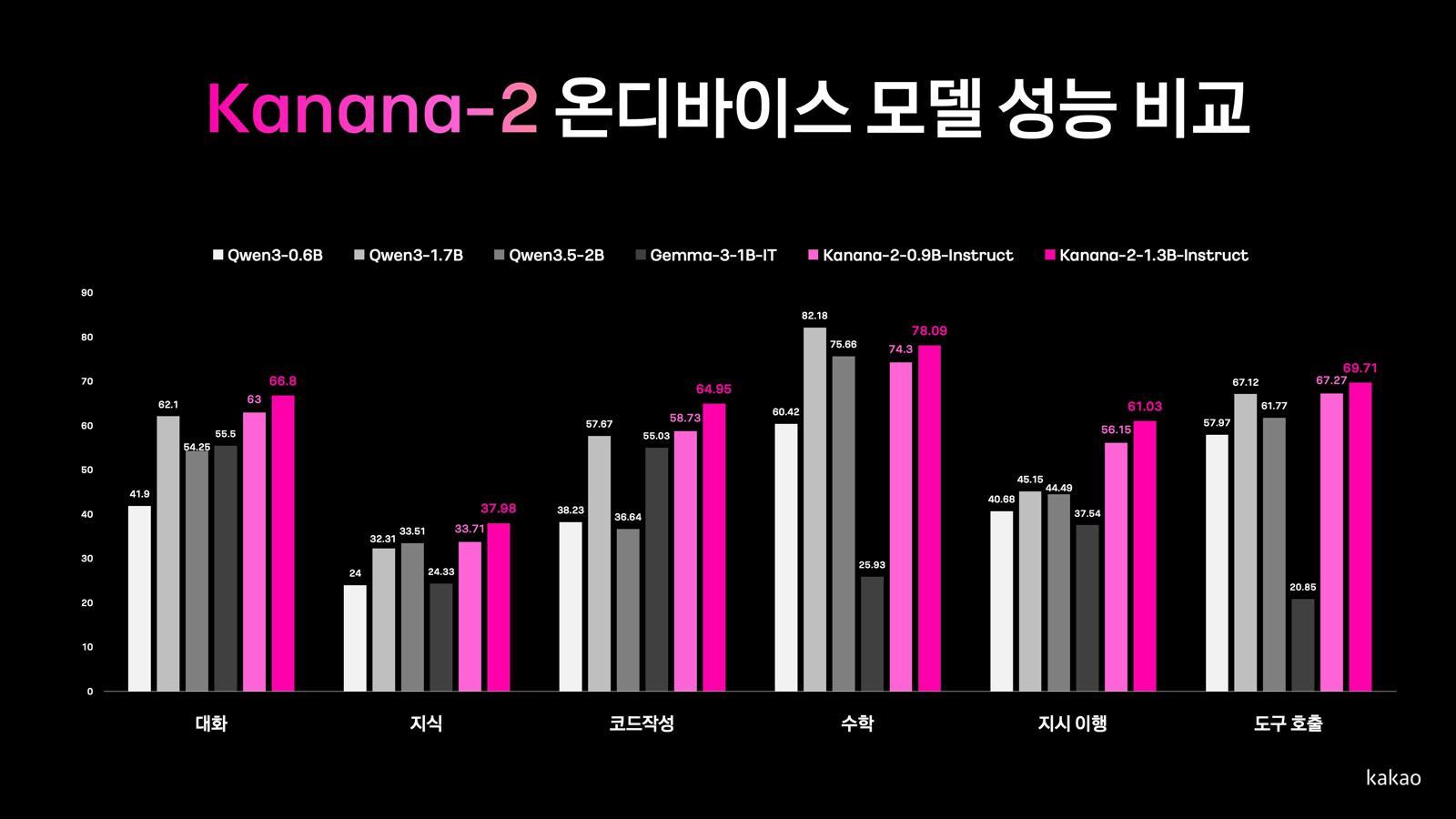
The Kanana-2 series is divided into two main models based on parameter count: 'Kanana 2-1.3B' with 1.3 billion parameters and 'Kanana 2-3B' with 3 billion parameters. Each of these is further available in a general (base) version and an instruction-following (instruct) version.
Kakao emphasized that despite being optimized for devices with limited memory, the models achieve global-standard performance. The company integrated its proprietary Korean-specific tokenizer, which enhances processing speed and improves text processing efficiency by over 30% compared to previous methods. This optimization allows for a reduction in memory usage by up to 72.7% even during long conversations involving approximately 24,000 words.
With commercial use permitted, Kakao aims to lower the operational cost barrier for large language models, thereby fostering AI service development among startups and research institutions. "We hope this open-source release leads to the development of AI services by various companies and invigorates the ecosystem," said Noh Byung-seok, Kakao Unified Foundation Model Performance Leader.
We hope this open-source release leads to the development of AI services by various companies and invigorates the ecosystem.
DistantNews Editorial
Originally published by Dong-A Ilbo in Korean. Translated, summarized, and contextualized by our editorial team with added local perspective. Read our editorial standards.
More Stories



From Our Blog

What Gets Lost (and Found) When News Is Translated

The Critical Role of Diaspora Media in Global News

What Travellers Should Know About Countries with Restricted Press

A Digital Nomad's Guide to Following Local News

How the Same Story Looks Different in Different Countries
