

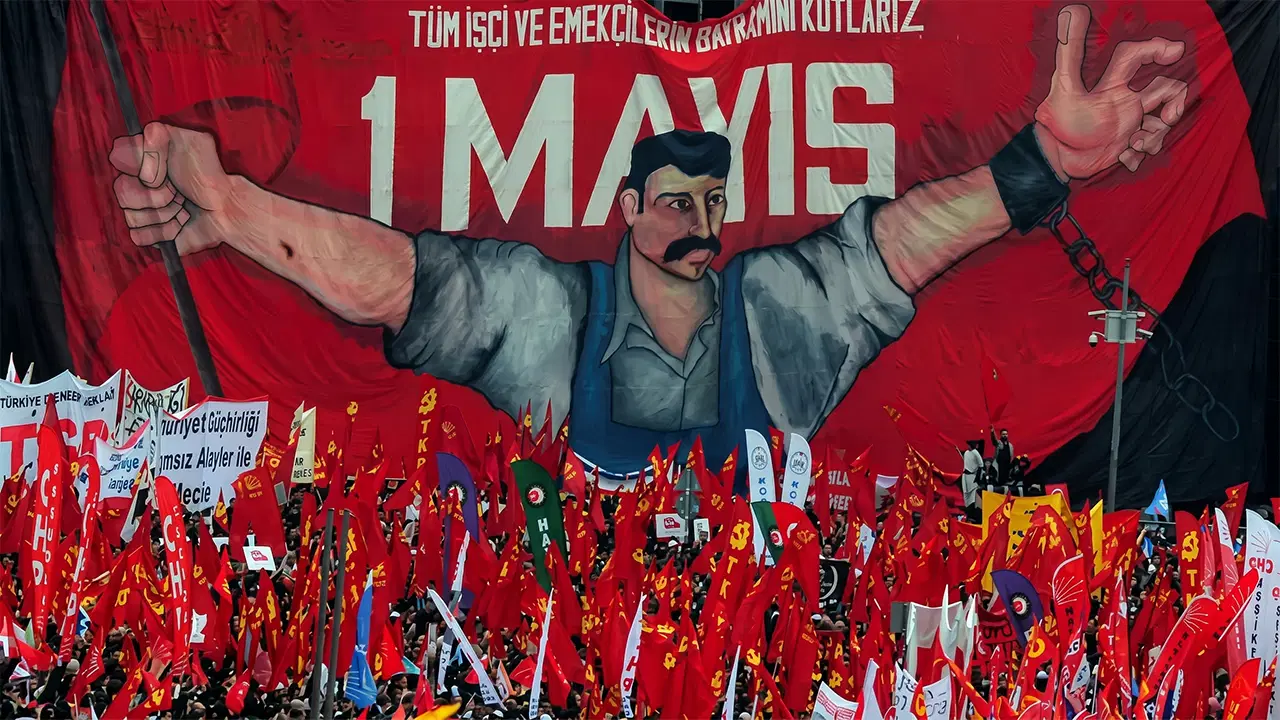
Kemalist Enlightenment Association's May 1st Message: 'Protecting Labor's Rights is Protecting the Republic'
Translated from Turkish, summarized and contextualized by DistantNews.
TLDR
- The Kemalist Enlightenment Association marked May 1st, Labor and Solidarity Day, with a statement emphasizing the protection of workers' rights as essential to safeguarding the Republic.
- The association highlighted that the Republic of Turkey, founded under Mustafa Kemal Atatürk, was built on principles of labor dignity and social justice, aiming for economic independence and social equity.
- The statement recalled the İzmir Economic Congress, which established concepts like 'worker' instead of 'laborer,' an eight-hour workday, and the right to weekly days off, underscoring the foundational importance of labor rights in the Republic's ideology.
On the occasion of May 1st, Labor and Solidarity Day, the Kemalist Enlightenment Association has issued a powerful statement reinforcing the core tenets upon which the Republic of Turkey was founded. The association, through its Board Member and Spokesperson Buket Müftüoğlu, stressed that the very philosophy of the Republic is intrinsically linked to the dignity of labor and the pursuit of social justice.
Protecting the rights of labor is protecting the Republic.
This perspective underscores that the Republic, established under the visionary leadership of Mustafa Kemal Atatürk, was not merely a political independence movement. It was a comprehensive societal transformation project aiming for economic sovereignty and social fairness. Labor, in this context, is not just a factor of production but the fundamental pillar supporting the nation's independence and development. This viewpoint aligns with the historical Kemalist ideology that prioritizes national sovereignty and self-sufficiency.
The association specifically referenced the İzmir Economic Congress, convened during the most challenging period of the War of Independence. This congress, held even before the Republic's proclamation, recognized that independence could not be solely military; it required a robust economic and social foundation. Key decisions from this congress, such as adopting the term 'işçi' (worker) over 'amele' (laborer), limiting the workday to eight hours, establishing the right to weekly rest, and implementing regulations for worker health, are presented as clear indicators of the value placed on labor from the Republic's inception.
The Republic of Turkey, founded under the leadership of Mustafa Kemal Atatürk, is not just a political independence movement; it is a profound civilization project that bases the dignity of labor on social justice and integrates production with social justice.
From the perspective of the Kemalist Enlightenment Association, protecting the rights of labor is synonymous with protecting the Republic itself. They argue that political independence is meaningless without economic independence, which in turn is impossible without the safeguarding of workers' rights. May 1st, therefore, is not just a day of commemoration but a reaffirmation of the Republic's founding principles: ensuring that labor receives its due value, fair working conditions are provided, and prosperity is shared equitably. This nationalistic and deeply rooted ideological stance is central to understanding the Turkish perspective on labor rights and their connection to national identity and progress.
The İzmir Economic Congress, convened during the most challenging period of the War of Independence, before the Republic was declared and while the country was in great scarcity, revealed that independence could not be limited to military victory alone; it had to be completed with economic sovereignty and social justice.
DistantNews Editorial
Originally published by Cumhuriyet in Turkish. Translated, summarized, and contextualized by our editorial team with added local perspective. Read our editorial standards.
More Stories
From Our Blog

What Gets Lost (and Found) When News Is Translated

The Critical Role of Diaspora Media in Global News

What Travellers Should Know About Countries with Restricted Press

A Digital Nomad's Guide to Following Local News

How the Same Story Looks Different in Different Countries
