


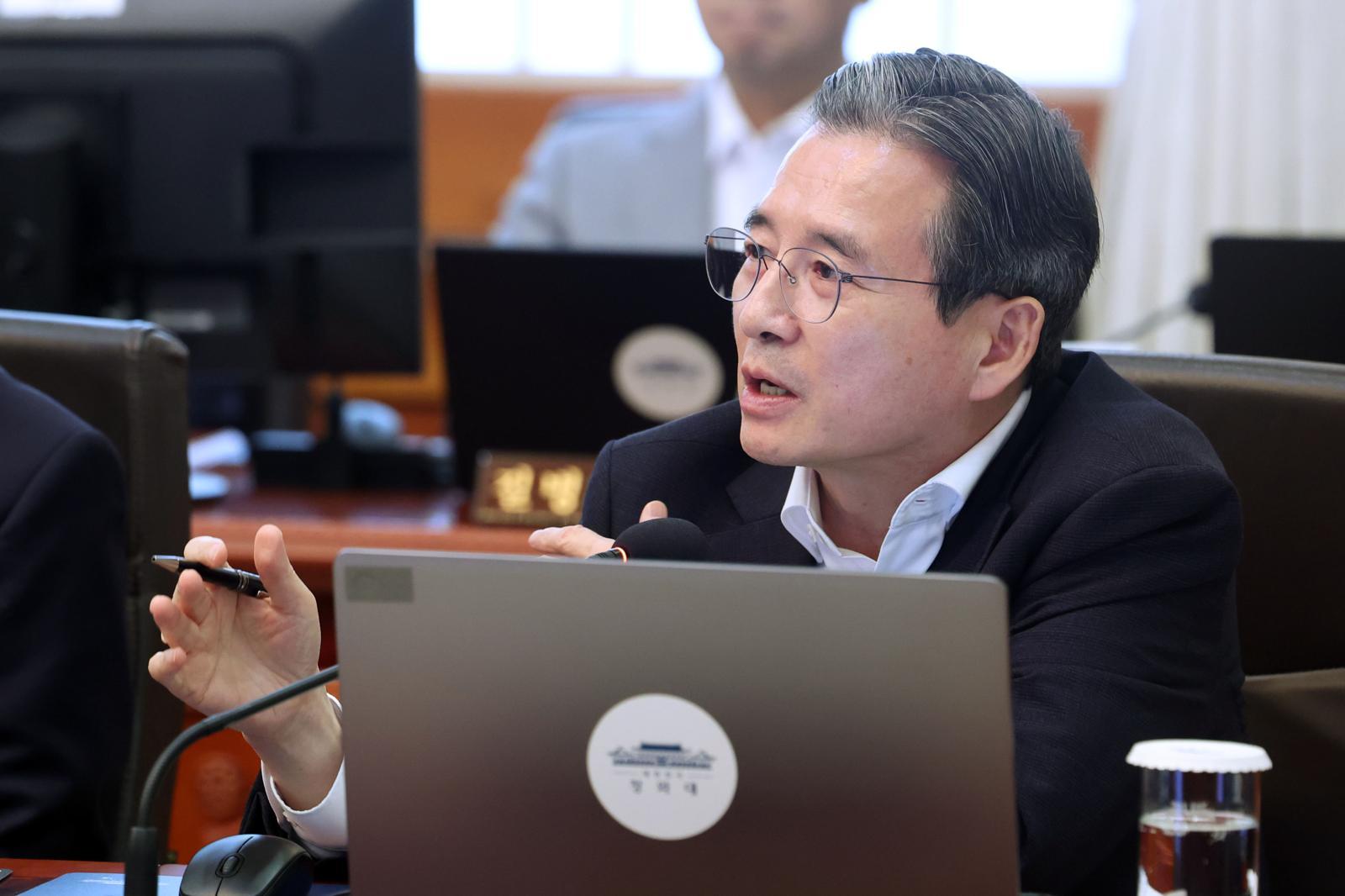
Kim Yong-beom: State's role in AI era is market organization, not production or control
Translated from Korean, summarized and contextualized by DistantNews.
At a glance
News
Sources not specified
New plan
- South Korea plans to establish an 'AI Basic Society' where all citizens can access AI services, according to Presidential Policy Chief Kim Yong-beom.
- The government aims to organize the market for AI services, rather than focusing on production or control, to prevent a digital divide.
- Key initiatives include a universal chatbot, AI-powered welfare service applications, and AI utilization education for over 5 million people.
South Korea aims to create an "AI Basic Society" ensuring all citizens can access artificial intelligence services, as outlined by Presidential Policy Chief Kim Yong-beom. This initiative seeks to guarantee a minimum level of computing access for everyone, akin to providing a fishing rod rather than the fish itself, empowering individuals with the ability to produce and utilize AI.
The state in the AI era is not a producing state, nor a controlling state. It is a state that organizes the market.
Kim described the role of the state in the AI era not as a producer or controller, but as an organizer of the market. He noted that while many citizens use AI services, a robust market for AI applications in sectors like healthcare, education, and administration has yet to fully emerge due to regulatory hurdles, data access issues, and trust concerns. Kim characterized this as a "locked market" that requires a strong push to open.
While acknowledging China's model of state-led market organization, Kim differentiated South Korea's approach. He warned that a state-driven system, while effective in opening markets, can lead to ownership and control issues, ultimately closing off societal possibilities. South Korea's path, he emphasized, is different.
Ensuring that all citizens have at least minimal computing power is different from welfare that distributes cash. Computing is closer to giving everyone a fishing rod, rather than giving them a fish or teaching them to fish.
The "AI for All" policy is central to this vision. It includes a universal chatbot utilizing domestic AI models, set to be available without usage fees or limits starting December. By the second half of 2027, a "1 person 1 agent" service will help vulnerable populations access welfare services. Other planned services include agricultural price comparisons and personalized tax consultations. The government also plans AI utilization education for over 5 million people by year-end.
This locked market is rather opened by a system where the state pushes strongly. China is like that.
Kim stressed that AI accessibility is a matter of national security, as over-reliance on foreign AI infrastructure could leave the country vulnerable. He also argued that AI proficiency will increasingly determine income, opportunity, and growth, making access to AI a fundamental right. The state's role is to ensure no one is excluded from this digital future. He likened the nation's AI potential to scattered pearls, with the state's task being to string them together into a valuable necklace, thereby creating the AI Basic Society.
If the state strongly organizes the initial market and opens the door, the problems become apparent. This method does not stop at opening the door; it moves on to ownership and control. The state creates, the state uses, and the state owns. Possibilities open up, but the society that opens those possibilities closes down. That is not the path we are taking.
DistantNews Editorial
Originally published by Dong-A Ilbo in Korean. Translated, summarized, and contextualized by our editorial team with added local perspective. Read our editorial standards.
More Stories


From Our Blog

What Gets Lost (and Found) When News Is Translated

The Critical Role of Diaspora Media in Global News

What Travellers Should Know About Countries with Restricted Press

A Digital Nomad's Guide to Following Local News

How the Same Story Looks Different in Different Countries
