


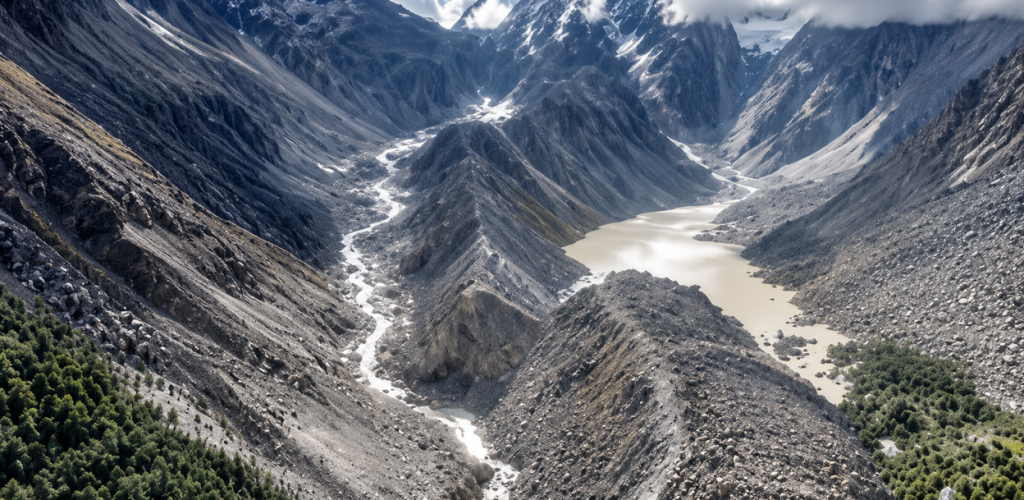
Lake burst risk low in Rasuwa, experts caution against rumors
Translated from English and summarized by DistantNews. Read the original for the full story.
At a glance
News
Sources not specified
Ongoing story
- Technical experts state the immediate risk of a lake burst in Rasuwa has decreased as water now flows naturally from the newly formed body.
- Rumors of an imminent lake burst have negatively impacted ongoing search and rescue operations in downstream areas.
- While the immediate threat has lessened, experts advise continued monitoring due to the potential for fresh landslides to trigger renewed flooding.
The immediate danger posed by a water body formed by an ice-rock avalanche in Nepal's Rasuwa district has significantly diminished, according to technical experts. Officials from the Department of Hydrology and Meteorology report that the risk of a sudden lake burst has reduced because water has begun to flow out naturally.
Normally, unstable lakes burst soon after filling up. This lake has filled and started releasing water, and more than 24 hours have passed without a breach. Once water begins flowing out, the possibility of the lake bursting decreases.
Experts are also concerned that the spread of rumors about an imminent lake burst is disrupting crucial search and rescue efforts in areas downstream. Binod Parajuli, chief of the Flood Forecasting Division, noted that the lake's natural overflow and the passage of over 24 hours without a breach have decreased the likelihood of a sudden event. "Once water begins flowing out, the possibility of the lake bursting decreases," he explained.
Geologist Shri Kamal Dwivedi emphasized that the water accumulation in a depression caused by an ice-rock fall should not automatically be labeled a "lake at risk of bursting." He distinguished between water filling a depression and a lake's catastrophic failure. Dwivedi added that unfounded rumors about a potential flood have hindered rescue operations.
Water filling a depression and flowing out is different from a lake bursting.
Recent surveys identified two water bodies in the Langtang Lirung region, holding an estimated 50,000 cubic meters of water. Officials noted that one outlet has opened, allowing gradual drainage. Experts believe that even a worst-case breach would not be as destructive as the previous flood, which released an estimated 20 million cubic meters of water and debris. However, the primary concern now is the potential for new landslides to fall into the water bodies, triggering further flooding, especially as debris from the earlier flood has already raised the riverbed.
The flood debris from Wednesday has already raised the riverbed. If another flood occurs, there could be risks along the riverbanks.
About this summary
Originally published by OnlineKhabar English in English. Translated, summarized, and contextualized automatically by DistantNews, with a note on how the source frames the story. Not individually reviewed before publishing. How this works.
More Stories

From Our Blog

What Gets Lost (and Found) When News Is Translated

The Critical Role of Diaspora Media in Global News

What Travellers Should Know About Countries with Restricted Press

A Digital Nomad's Guide to Following Local News

How the Same Story Looks Different in Different Countries
