


Lake cores show 2012 Rwenzori wildfire was first in 12,000 years, with 100-fold charcoal rise
Summarized and contextualized by DistantNews.
At a glance
News
Named sources
Outcome reported
- A 2012 wildfire in Uganda and the Democratic Republic of the Congo's Rwenzori Mountains was the first large-scale fire in the region in 12,000 years.
- Analysis of lake sediment cores revealed a charcoal signature over 100 times greater than any previously recorded.
- Researchers attribute the unprecedented fire to climate change and increased human influence on the unique Afroalpine ecosystem.
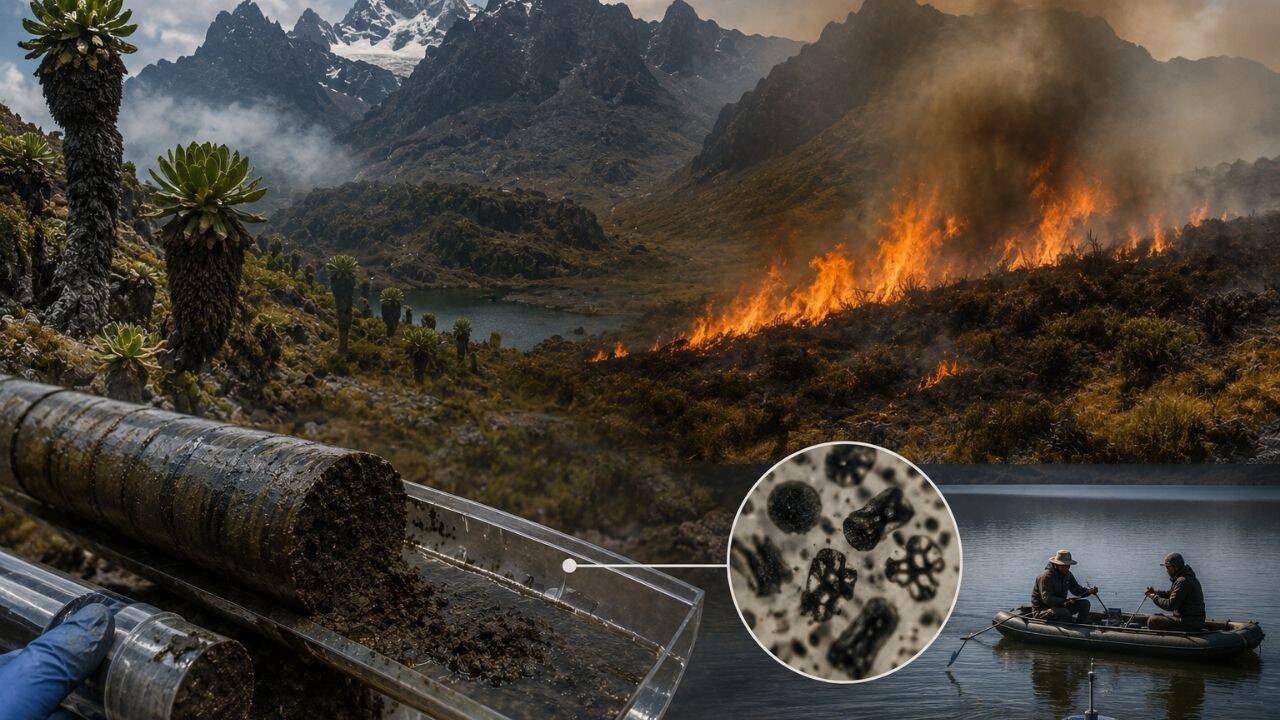
A wildfire that ravaged the high-altitude alpine zone of Africa's Rwenzori Mountains in 2012 stands out as the first major fire event in the region in at least 12,000 years, according to a study published in Nature. By examining ancient lake sediment cores, scientists reconstructed the mountains' fire history and discovered an unprecedented charcoal signature from the 2012 blaze, more than 100 times higher than any recorded in the preceding 12 millennia.
The findings suggest that climate change and growing human impact are exposing one of Africa's most unique mountain ecosystems to a threat it had largely avoided throughout the Holocene epoch. Researchers collected sediment cores from two lakes in the Rwenzori Mountains, which straddle the border between Uganda and the Democratic Republic of the Congo. These sediments act as natural archives, preserving layers of pollen, plant waxes, microscopic organisms, and charcoal that reveal past environmental conditions.
The study focused on charcoal as a reliable indicator of past fires. The core from Lake Kopello, situated in the alpine zone at approximately 13,000 feet, showed virtually no evidence of major fires over the last 12,000 years. However, the layer corresponding to 2012 exhibited a dramatic increase in charcoal concentration, signifying an event unlike any other in the geological record.
This enormous charcoal spike indicates that the 2012 wildfire was not part of a natural fire cycle but an anomaly in the region's recent geological history. The fire burned about 42 square kilometers of alpine moorland above 13,000 feet. Scientists had previously assumed these high-altitude ecosystems, characterized by cold, wet conditions and frequent mist, were naturally protected from wildfires.
The Rwenzori Mountains, often called the "Mountains of the Moon," host rare Afroalpine ecosystems with endemic species. These isolated habitats, sometimes termed "sky islands," evolved in the absence of large fires. The study posits that a combination of warming temperatures and human activities is likely increasing the risk of fires igniting and spreading in landscapes that were historically too wet to burn.
DistantNews Editorial
Originally published by Times of India. Summarized and contextualized by our editorial team with added local perspective. Read our editorial standards.
More Stories

From Our Blog

What Press Freedom Means for the News You Read

What Gets Lost (and Found) When News Is Translated

The Critical Role of Diaspora Media in Global News

What Travellers Should Know About Countries with Restricted Press

A Digital Nomad's Guide to Following Local News
