


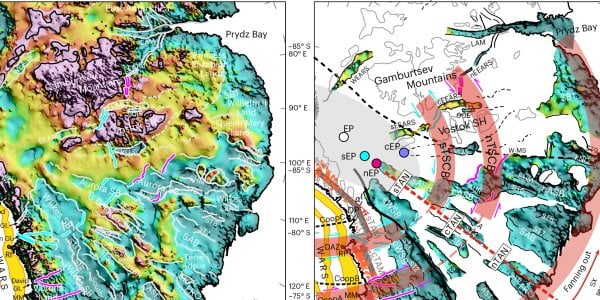
Lost World Under Antarctic Ice: Giant Hand-Shaped Structure Discovered
Translated from Polish, summarized and contextualized by DistantNews.
At a glance
News
Named sources
Context piece
- Scientists have discovered a massive, fan-shaped subglacial structure in East Antarctica, stretching over 3 kilometers beneath the ice.
- This megastructure connects previously identified features like the Wilkes and Aurora basins, and includes Lake Vostok.
- The discovery significantly alters the understanding of East Antarctica's geological evolution, with its formation possibly linked to rotational stretching or tectonic events.
A vast, fan-shaped geological structure, unlike anything seen before on Earth, has been uncovered beneath the ice sheet of East Antarctica. This colossal formation, located more than 3 kilometers below the frozen surface, spans continental dimensions and has scientists re-evaluating the region's geological history.
The newly discovered system connects several previously identified subglacial basins, including the Wilkes and Aurora basins, and notably encompasses Lake Vostok, the largest known subglacial lake, isolated for millions of years. Researchers from the University of Genoa, publishing in "Nature Geoscience," describe this as a single, large-scale continental architecture.
"These studies have allowed us to connect structures that until now were considered separate or independent," stated Egidio Armadillo, lead author of the study and professor of applied geophysics at the University of Genoa. "Recognizing one, large-scale continental architecture significantly changes our understanding of the geological evolution of East Antarctica," he added.
Observing this immense structure is impossible from the surface. Its discovery required integrating data from multiple sources, including gravitational measurements, magnetic data, seismic information, subglacial topography, geological observations, and crustal and lithospheric models. This comprehensive approach allowed researchers to effectively "scan" the ice sheet.
The origin of this massive formation remains a subject of investigation. Its radiating, outward-spreading shape suggests it may have formed through a process of distributed rotational stretching, where the continental crust gradually expanded from a central point. Scientists theorize this could have occurred during periods of significant erosion around 250-300 million years ago, the breakup of the supercontinent Gondwana between 65 and 200 million years ago, or periods of fault displacement approximately 35-55 million years ago.
These studies have allowed us to connect structures that until now were considered separate or independent. Recognizing one, large-scale continental architecture significantly changes our understanding of the geological evolution of East Antarctica.
DistantNews Editorial
Originally published by Rzeczpospolita in Polish. Translated, summarized, and contextualized by our editorial team with added local perspective. Read our editorial standards.
More Stories



From Our Blog

What Gets Lost (and Found) When News Is Translated

The Critical Role of Diaspora Media in Global News

What Travellers Should Know About Countries with Restricted Press

A Digital Nomad's Guide to Following Local News

How the Same Story Looks Different in Different Countries
