


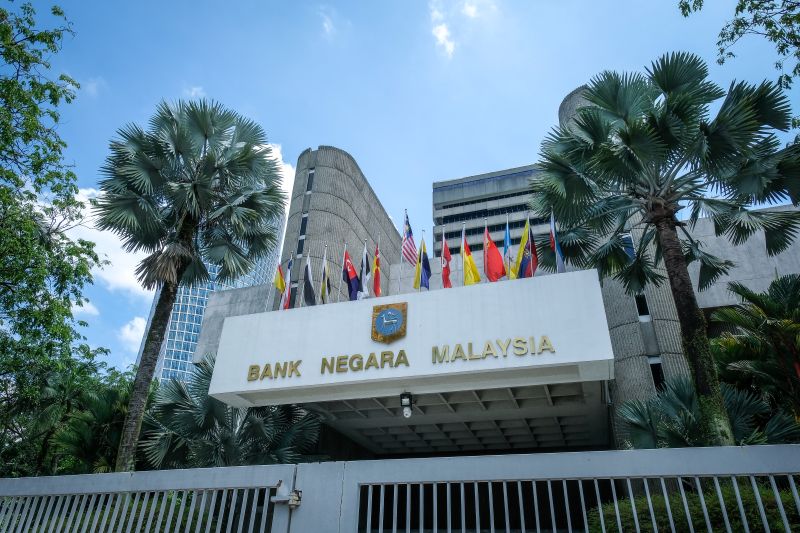
Malaysia's central bank likely to hold interest rates steady amid controlled inflation
Translated from Malay, summarized and contextualized by DistantNews.
At a glance
News
Named sources
New plan
- Bank Negara Malaysia's Monetary Policy Committee is expected to maintain the Overnight Policy Rate (OPR) at 2.75% due to controlled inflation and steady economic growth supported by domestic demand.
- Experts cite a stable labor market and the need to balance economic support with price stability as reasons for keeping the OPR unchanged.
- The central bank will continue to monitor inflation, economic growth, the ringgit's value, and global economic trends, particularly US interest rates, in its monetary policy decisions.
Bank Negara Malaysia's Monetary Policy Committee (MPC) is widely expected to hold the Overnight Policy Rate (OPR) at 2.75% at its upcoming meeting. This decision is driven by a favorable economic outlook, characterized by controlled inflation and moderate economic growth bolstered by robust domestic demand.
The trajectory of inflation, the momentum of domestic economic growth, the stability of the ringgit's value, and global economic developments, especially the direction of US interest rates, are the main factors for the central bank in making this policy decision.
Economists point to a stable labor market as a key factor, suggesting no urgent need to alter the current monetary policy stance. The trajectory of inflation, the momentum of domestic economic growth, the stability of the Malaysian ringgit, and global economic developments, especially the direction of US interest rates, are the primary considerations for the central bank.
BNM is also assessing the growth prospects for the second half of the year to ensure monetary policy continues to support the economy without creating excessive inflation risks.
BNM is also assessing the economic growth prospects for the second half of the year to ensure monetary policy supports the economy without fueling excessive inflation. The main challenge for BNM is to strike a balance between stimulating economic growth and maintaining price stability, while also preserving investor confidence in the nation's economy. Therefore, maintaining the OPR and adopting a data-driven monetary policy approach, with readiness to adjust if economic prospects change significantly, is deemed the most appropriate strategy.
The main challenge for BNM right now is to balance the need to support economic growth while ensuring price stability and maintaining investor confidence in the country's economy.
The last adjustment to the OPR was in July 2025, when it was lowered from 3% to 2.75% to support economic growth amidst external challenges. Changes in the OPR can influence the stock market through financing costs, consumer spending, corporate profits, and investor sentiment, though the impact varies by sector due to differing sensitivities to interest rate changes. For instance, higher OPR typically boosts bank profit margins, while lower rates can stimulate loan growth. The property sector is particularly sensitive, with lower rates encouraging purchases and higher rates dampening demand. Lower interest rates also increase household disposable income, supporting consumer spending.
Therefore, the most appropriate approach is to maintain the OPR while continuing to adopt a data-driven monetary policy and be prepared to make adjustments if the economic outlook changes significantly.
DistantNews Editorial
Originally published by Utusan Malaysia in Malay. Translated, summarized, and contextualized by our editorial team with added local perspective. Read our editorial standards.
More Stories



From Our Blog

What Gets Lost (and Found) When News Is Translated

The Critical Role of Diaspora Media in Global News

What Travellers Should Know About Countries with Restricted Press

A Digital Nomad's Guide to Following Local News

How the Same Story Looks Different in Different Countries
