

Malaysia Unveils 'Tuah': Indigenous Robot Enhances Border Security and Technological Prowess
Translated from Malay, summarized and contextualized by DistantNews.
TLDR
- Malaysia has developed 'Tuah,' an indigenous Unmanned Ground Vehicle (UGV) designed for border security and anti-smuggling operations.
- Developed by Deftech in collaboration with Universiti Malaysia Pahang Al-Sultan Abdullah (UMPSA), Tuah is the first Malaysian-made UGV.
- The robot can operate autonomously, identify threats, and can be equipped with heavy weaponry, enhancing national defense capabilities and technological sovereignty.
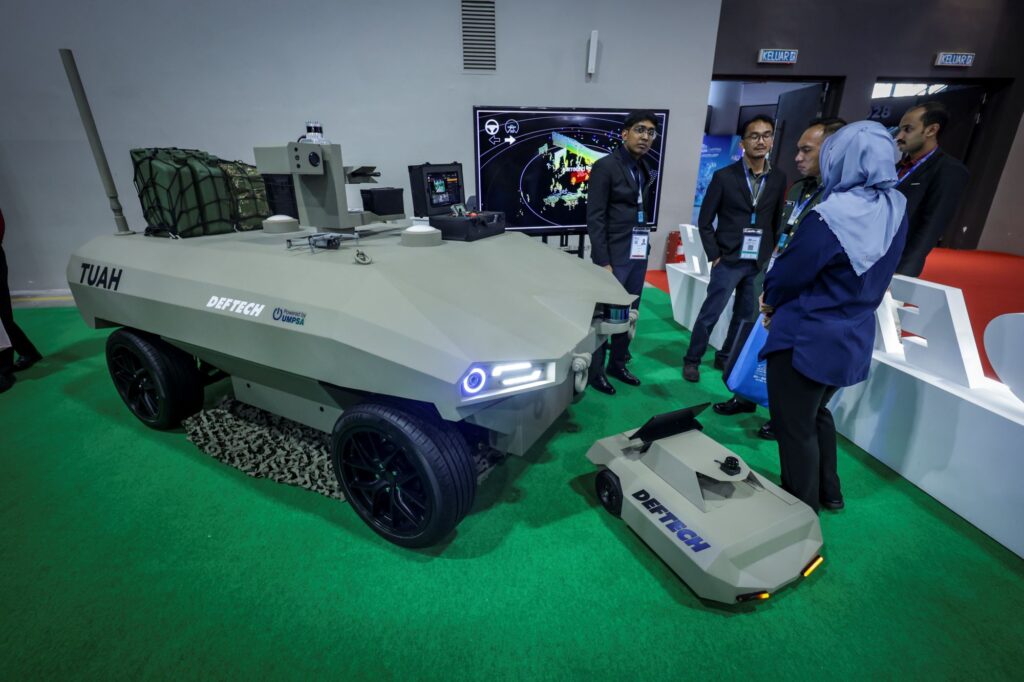
Malaysia is taking a significant leap forward in its defense capabilities with the unveiling of 'Tuah,' an innovative Unmanned Ground Vehicle (UGV) developed entirely by local talent. This groundbreaking robot, a product of collaboration between DRB-HICOM Defence Technologies Sdn Bhd (Deftech) and Universiti Malaysia Pahang Al-Sultan Abdullah (UMPSA), represents a major stride in the nation's pursuit of technological sovereignty in defense.
Tuah is also capable of becoming a weapons system for dangerous areas without requiring direct human involvement, equipped with a 12.7 millimeter (MM) heavy machine gun.
Tuah is not just a symbol of innovation; it is a practical tool designed to bolster national security. Its primary role is to patrol and safeguard Malaysia's borders, effectively deterring illegal crossings and combating smuggling activities. As the first UGV manufactured in Malaysia, Tuah embodies the nation's growing expertise in advanced robotics and autonomous systems.
Tuah is an autonomous vehicle that does not require internet and uses electricity, besides being able to reach speeds of up to 40 kilometers per hour (km/h) and 100 km/h if using a remote control.
What makes Tuah particularly impressive is its versatility and advanced features. It operates autonomously, utilizing sophisticated software developed by UMPSA to detect suspicious movements and alert command centers. The UGV is electric-powered, capable of reaching speeds up to 40 km/h, and can be remotely controlled to achieve speeds of 100 km/h. Furthermore, it can be armed with a 12.7mm heavy machine gun, enabling it to engage threats in dangerous areas without direct human involvement, thereby minimizing risks to personnel.
The software developed by UMPSA can recognize behavior or detect movement and then inform the command center.
Prof. Dr. Muhammad Aizzat Zakaria, Director of UMPSA's Innovation and Technology Transfer Center, emphasized the critical importance of developing indigenous technology for national security. He stated, "We need to keep up with technology. What UMPSA prioritizes is technological sovereignty itself, where we need local expertise to develop technology that we can use for our national security." This focus on local development ensures that sensitive data remains within Malaysia's control, safeguarding national secrets from potential foreign adversaries. Tuah is a testament to Malaysia's commitment to building a robust, self-reliant defense sector.
Robots don't have to be big; we have to keep up with technology. Among the things UMPSA prioritizes is technological sovereignty itself, where we need local expertise to develop technology that we can use for our national security.
DistantNews Editorial
Originally published by Utusan Malaysia in Malay. Translated, summarized, and contextualized by our editorial team with added local perspective. Read our editorial standards.
More Stories

From Our Blog

What Gets Lost (and Found) When News Is Translated

The Critical Role of Diaspora Media in Global News

What Travellers Should Know About Countries with Restricted Press

A Digital Nomad's Guide to Following Local News

How the Same Story Looks Different in Different Countries
