


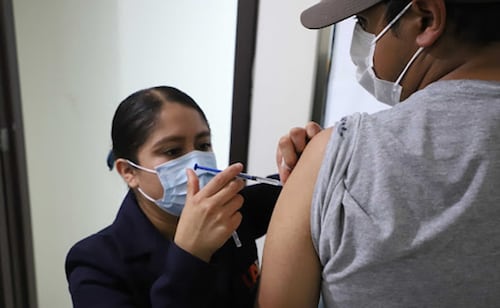
National Vaccination Week 2026: Health Reports Over 2 Million Doses Administered; Campaign Continues Through May
Translated from Spanish, summarized and contextualized by DistantNews.
TLDR
- Mexico's National Vaccination Week administered over 2.3 million doses, exceeding its national goal by 139%.
- The vaccination campaign will continue throughout May to expand coverage.
- The success is attributed to coordinated efforts among various health sector entities.
El Universal reports a resounding success for Mexico's National Vaccination Week 2026, with health authorities administering an impressive 2,388,493 doses. This figure not only meets but significantly surpasses the national target, achieving 139% of the programmed goal.
The Secretariat of Health has announced that the vaccination drive will extend throughout May, ensuring continued efforts to broaden immunization coverage across the country. This extended period aims to reach more individuals and reinforce the protection offered by essential vaccines.
This result was possible thanks to the coordinated work of the health sector, with the participation of the Secretariat of Health, the IMSS, IMSS-Bienestar, ISSSTE, Pemex, as well as the Secretariat of the Navy and the Secretariat of National Defense, who jointly strengthened vaccination actions throughout the country.
This remarkable achievement is credited to the robust and coordinated collaboration between key players in the health sector. The Secretariat of Health, alongside institutions such as IMSS, IMSS-Bienestar, ISSSTE, Pemex, the Secretariat of the Navy, and the Secretariat of National Defense, worked in unison to bolster vaccination actions nationwide. This inter-agency cooperation has been fundamental in achieving such high vaccination rates.
Several federal entities exceeded their individual vaccination targets, a testament to the effective coordination between state health services and national institutions. The campaign administered a wide range of vaccines, including those for measles and rubella (SR), measles, rubella, and mumps (SRP), tetanus (TD), pneumococcus, hepatitis B, and the Respiratory Syncytial Virus (VSR) vaccine for pregnant women. Priority was given to children, adolescents, and at-risk groups, reflecting a comprehensive public health strategy. From a Mexican perspective, this coordinated national effort highlights our capacity for collective action in safeguarding public health, a model that prioritizes community well-being through unified governmental and institutional endeavors.
It is noteworthy that various federal entities managed to exceed 100 percent of their established goals, as a result of the coordinated work between state health services and sector institutions.
DistantNews Editorial
Originally published by El Universal in Spanish. Translated, summarized, and contextualized by our editorial team with added local perspective. Read our editorial standards.
More Stories



From Our Blog

What Press Freedom Means for the News You Read

What Gets Lost (and Found) When News Is Translated

The Critical Role of Diaspora Media in Global News

What Travellers Should Know About Countries with Restricted Press

A Digital Nomad's Guide to Following Local News
