


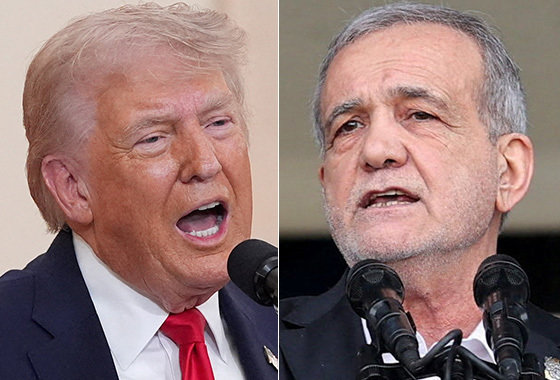
‘Negotiator’ Iranian President Clashes with Revolutionary Guard Over UAE Attack
Translated from Korean, summarized and contextualized by DistantNews.
TLDR
- Iranian President Masoud Pezeshkian expressed strong anger over an attack by the Islamic Revolutionary Guard Corps (IRGC) on the UAE.
- The IRGC allegedly conducted the missile and drone strikes without prior government consultation, leading to a fire at a UAE petrochemical complex.
- This incident highlights a growing rift within Iran's leadership between 'negotiation' factions and hardliners, with the IRGC appearing to consolidate power.
A significant internal rift within Iran's leadership has become increasingly apparent following renewed attacks in the Persian Gulf region, occurring approximately one month after a fragile ceasefire took hold. The situation escalated dramatically when Iranian President Masoud Pezeshkian reportedly voiced intense displeasure regarding an attack carried out by the Islamic Revolutionary Guard Corps (IRGC) against the United Arab Emirates (UAE).
completely irresponsible
According to reports from Iran International, a UK-based dissident media outlet, the IRGC launched missile and drone strikes targeting the UAE without obtaining prior approval from the government. This unilateral action resulted in a fire at the Fujairah petrochemical complex, a key energy facility in the UAE. President Pezeshkian is said to have condemned the attack as "completely irresponsible" and described the escalation of tensions with neighboring countries as "madness," warning of potentially irreversible consequences.
Pezeshkian, identified as a member of the 'negotiation' faction within Iran's leadership, appears to be in direct conflict with hardline elements, particularly the IRGC. This internal friction is intensifying following the death of Supreme Leader Ayatollah Ali Khamenei and the subsequent rise of Mojtaba Khamenei. Reports suggest that the military, led by the IRGC and its new commander Ahmad Vahidi, has effectively seized control of core state functions. The IRGC has previously undermined President Pezeshkian's authority, such as obstructing his appointment of a Minister of Intelligence. The President's attempts to convene an emergency meeting with Mojtaba Khamenei were reportedly blocked by IRGC officials, further isolating the president.
madness
Adding another layer of complexity, some analysts suggest that Iran may be strategically leveraging this internal division as a bargaining chip in international negotiations. The 'negotiation' faction could use the hardliners as a pretext to demand concessions, while the hardliners might label the pragmatists as 'traitors' to increase the cost of compromise. By publicly denying internal divisions while maintaining ambiguity about the ultimate decision-maker, Iran could be creating uncertainty for its negotiating partners. This was echoed by U.S. President Donald Trump, who recently expressed frustration, stating, "The problem we're having is nobody knows for sure who the leader of Iran is. That's a bit of a headache."
The problem we're having is nobody knows for sure who the leader of Iran is. That's a bit of a headache.
DistantNews Editorial
Originally published by Dong-A Ilbo in Korean. Translated, summarized, and contextualized by our editorial team with added local perspective. Read our editorial standards.
More Stories


From Our Blog

What Gets Lost (and Found) When News Is Translated

The Critical Role of Diaspora Media in Global News

What Travellers Should Know About Countries with Restricted Press

A Digital Nomad's Guide to Following Local News

How the Same Story Looks Different in Different Countries
