

New Evidence Suggests Polish Communist Security Services Bugged Mokotów Prison
Translated from Polish, summarized and contextualized by DistantNews.
At a glance
News
Documents & data
Context piece
- Newly discovered documentation suggests Polish communist-era security services (MBP) may have bugged and recorded prisoner conversations at Mokotów Prison between 1950 and 1956.
- The findings raise questions about whether Kazimierz Moczarski, author of "Conversations with the Executioner," was among those monitored.
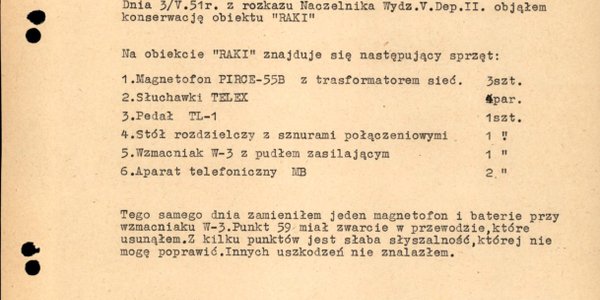
- The "Raki" listening post was reportedly maintained during this period, with a report detailing its equipment and repairs from May 1951.
Newly uncovered documentation indicates that Poland's communist-era Ministry of Public Security (MBP) may have operated a secret listening post to monitor and record conversations of prisoners at Warsaw's Mokotów Prison between 1950 and 1956. This discovery raises questions about the extent of surveillance during that era, particularly concerning Kazimierz Moczarski, whose seminal work "Conversations with the Executioner" is based on his interviews with high-ranking Nazi officials imprisoned there.
The findings stem from recently surfaced documents, including a "strictly confidential" report from May 12, 1951, detailing the maintenance of a facility designated "PP Raki" on May 3 of the same year. This report lists equipment and describes repairs performed on the listening post. During the period between November 1950 and May 1951, Moczarski shared prison cells with figures like Jürgen Stroop and Gustav Schilke, individuals whose conversations formed the basis of Moczarski's influential book.
Historians and researchers are now examining whether these conversations, crucial to one of Poland's most significant works of non-fiction literature, could have been intercepted and recorded by the security apparatus. The existence and operation of the "Raki" facility suggest a deliberate effort by the MBP to gather intelligence from within the prison walls, potentially impacting the historical record and Moczarski's own experiences.
DistantNews Editorial
Originally published by Rzeczpospolita in Polish. Translated, summarized, and contextualized by our editorial team with added local perspective. Read our editorial standards.
More Stories



From Our Blog

What Gets Lost (and Found) When News Is Translated

The Critical Role of Diaspora Media in Global News

What Travellers Should Know About Countries with Restricted Press

A Digital Nomad's Guide to Following Local News

How the Same Story Looks Different in Different Countries
