


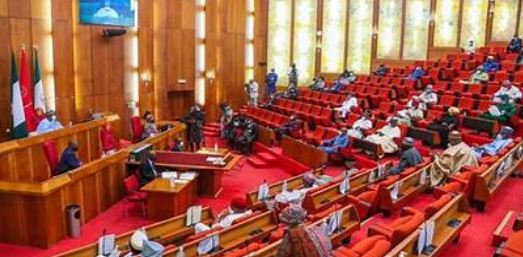
Nigerian Senate threatens sanctions over agencies' failure to implement resolutions
Translated from English, summarized and contextualized by DistantNews.
At a glance
News
Named sources
Context piece
- The Nigerian Senate is concerned that government agencies are not implementing its resolutions, threatening sanctions.
- Agencies routinely ignore oversight requests, hindering the Senate's authority, according to a committee report.
- Non-implementation is sometimes due to a lack of budgeted funds for projects like road rehabilitation and disaster management.
The Nigerian Senate is poised to impose budgetary sanctions on government ministries, departments, and agencies (MDAs) that fail to implement its resolutions. This move comes after a report by the Senate Committee on Legislative Compliance revealed a widespread disregard for the upper chamber's oversight authority.
Implementation of Senate resolutions is often delayed and sometimes ignored. The Executive retains the final authority to issue directives for the implementation of Senate resolutions.
Senator Musa Maidoki Garba, the committee chairman, presented a report detailing how many Senate resolutions are either delayed or completely ignored. He explained that the Executive branch ultimately controls the execution of these resolutions, often leading to delays or inaction. Garba also highlighted that some agencies cite a lack of budgeted funds as a reason for not carrying out resolutions, particularly those concerning road rehabilitation and disaster management.
Many MDAs ignore the committee’s requests for compliance information, thereby disregarding the powers of the committee and the Senate in general.
The committee's report also brought attention to specific unresolved cases. One such case involves the Federal Government's failure to compensate the family of a two-year-old boy, Eromonsele Omhonria, who was shot by a stray bullet during a National Drug Law Enforcement Agency (NDLEA) operation. The Senate had previously recommended N200 million in compensation and funding for the child's medical treatment abroad, but the NDLEA has yet to facilitate this due to funding issues related to confiscated properties.
Some MDAs failed to implement Senate resolutions, especially those relating to road rehabilitation and disaster management, due to the non-inclusion of funds in the budget for project execution.
Another instance cited is the Nigerian Railway Corporation's non-compliance with a Senate directive to reinstate a former employee, Engr. Paddy Ukpe. The committee recommended sanctions to enforce compliance, emphasizing the need for MDAs to respect the Senate's legislative and oversight functions.
The National Drug Law Enforcement Agency is yet to address the medical treatment of the child shot in the eye by one of its officers due to its inability to access funds from confiscated and forfeited properties to facilitate treatment abroad.
DistantNews Editorial
Originally published by Vanguard in English. Translated, summarized, and contextualized by our editorial team with added local perspective. Read our editorial standards.
More Stories



From Our Blog

How the Same Story Looks Different in Different Countries

What Gets Lost (and Found) When News Is Translated

The Critical Role of Diaspora Media in Global News

What Travellers Should Know About Countries with Restricted Press

A Digital Nomad's Guide to Following Local News
