


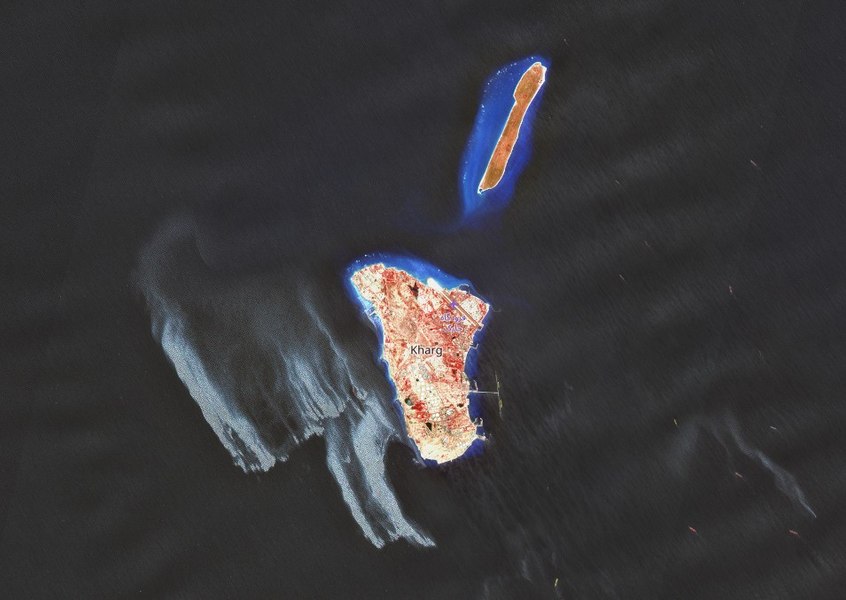
Oil slick spotted off Iran's Kharg Island coast; Trump blockade could lead to Persian Gulf spills
Translated from Romanian, summarized and contextualized by DistantNews.
TLDR
- A significant oil spill has been detected near Iran's Kharg Island, a major oil terminal, visible in satellite imagery.
- Experts suggest the spill could indicate Iran's oil infrastructure is struggling under U.S. sanctions pressure.
- The incident raises environmental concerns for the Persian Gulf and highlights potential issues with Iran's oil storage and export capacity.
A concerning oil slick, spanning approximately 45 square kilometers, has been detected by satellite imagery west of Iran's Kharg Island, the nation's primary oil export terminal. This incident, reported by Fox News and analyzed by Reuters, is being viewed by experts as a potential consequence of the intense pressure exerted by the United States, particularly through the "Economic Fury" campaign and naval presence aimed at restricting Iran's oil exports.
In this moment, I see two plausible explanations, which are not mutually exclusive.
Miad Maleki, an expert on sanctions and energy at the Foundation for Defense of Democracies, offers two plausible explanations for the spill. One is operational: Iran may have overproduced oil relative to its onshore storage capacity, relying on tankers to absorb the excess, only to find these tankers blocked by sanctions. The "solution" to this bottleneck appears to be discharging excess crude into the water. The second explanation points to mechanical failure, possibly due to Iran's use of aging vessels as floating storage or transport to circumvent sanctions. These older, poorly maintained ships may now be leaking.
One is operational: they simply did not reduce extraction fast enough relative to their actual onshore capacity and gambled too much that empty tankers would manage to get past the blockade. Now they have effectively delivered an excessive volume of crude oil into the export system, having more oil at or near the terminals than they can actually load, and the 'solution' is to dump some of this excess into the water.
Regardless of the exact cause, the common denominator is a critical mismatch between Iran's oil production capacity and its ability to store and export that oil. This imbalance, exacerbated by U.S. sanctions, is now having tangible environmental consequences for the Persian Gulf. The situation underscores the effectiveness of the U.S. strategy in overwhelming Iran's export system, potentially forcing risky and environmentally damaging compromises.
Another possible explanation is a mechanical failure related to Iran's use of aging tanks as floating storage or transporters that violate sanctions. They have put old and marginal ships back into service, using them as floating storage or as transport ships intended to circumvent sanctions, and some of these decommissioned or poorly maintained ships are now leaking.
This event occurs within the broader context of escalating U.S. pressure on Iran's oil sector. The "Project Freedom" initiative, which has seen numerous ships reportedly blocked in the Persian Gulf, further illustrates the complex geopolitical and economic factors at play. As Iran struggles to navigate these sanctions, the environmental health of the region is increasingly at risk, highlighting the far-reaching impacts of international political tensions on delicate ecosystems.
In any case, the common denominator is the same — storage and evacuation capacity is not synchronized with upstream production, and the Gulf is paying the price for this mismatch.
DistantNews Editorial
Originally published by Adevărul in Romanian. Translated, summarized, and contextualized by our editorial team with added local perspective. Read our editorial standards.
More Stories


From Our Blog

What Gets Lost (and Found) When News Is Translated

The Critical Role of Diaspora Media in Global News

What Travellers Should Know About Countries with Restricted Press

A Digital Nomad's Guide to Following Local News

How the Same Story Looks Different in Different Countries
