


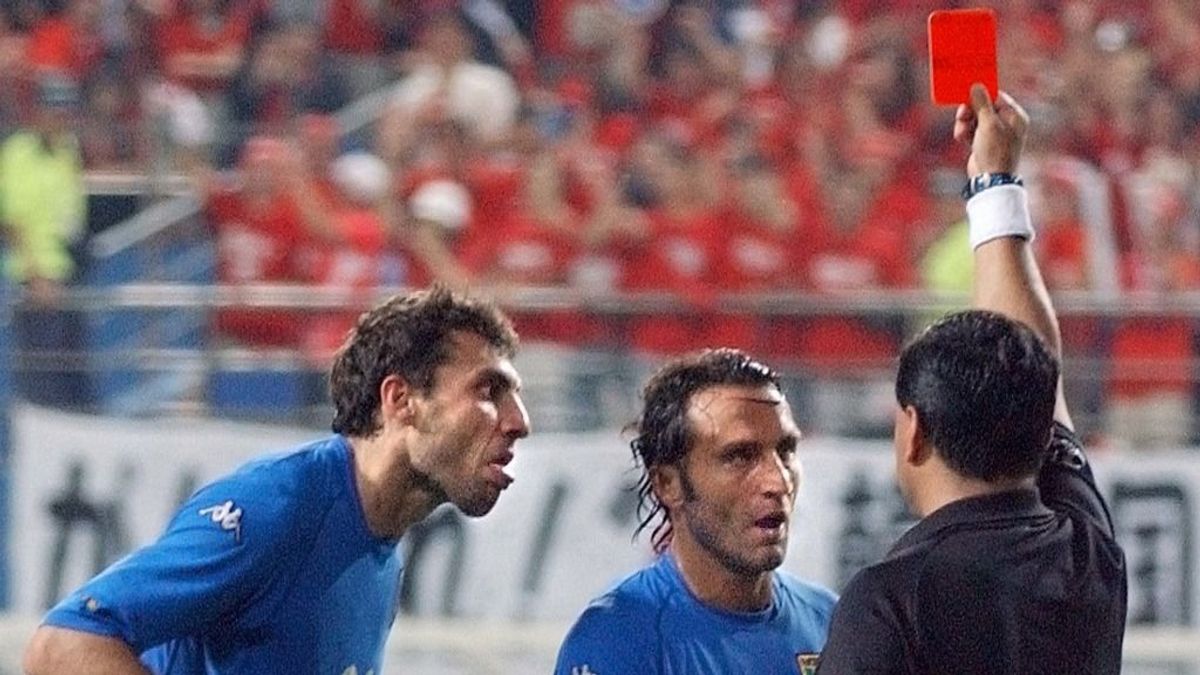
Outrageous Cheating Robbed Italians and Spaniards
Translated from Hungarian, summarized and contextualized by DistantNews.
TLDR
- The 2002 FIFA World Cup is remembered for controversial refereeing decisions that favored co-host South Korea, leading to accusations of bias from Italy and Spain.
- Italy felt robbed after a golden goal was disallowed and a penalty was awarded against them in their match against South Korea, officiated by Ecuadorian referee Byron Moreno.
- Spain also experienced questionable calls in their game against South Korea, fueling suspicions that FIFA aimed to keep the host nation in the tournament longer.
The 2002 FIFA World Cup, co-hosted by South Korea and Japan, remains a contentious chapter in football history, particularly for the Italian and Spanish delegations. Magyar Nemzet revisits this tournament not just as a sporting event, but as a stark reminder of how perceived 'sport diplomacy' and questionable officiating can dramatically alter outcomes, leaving a bitter taste for nations that felt unfairly treated.
Italy and Spain both felt that FIFA robbed them through the referees so that co-host South Korea could advance further.
Our focus today is on the matches involving South Korea, where the narrative of 'home advantage' seemed to extend far beyond the roar of the crowd. The encounters with Italy and Spain were particularly fraught. Italian coach Giovanni Trapattoni's premonitions proved accurate when Ecuadorian referee Byron Moreno took charge of the match against South Korea. The awarding of a penalty in the 5th minute for a seemingly minor shirt pull, and the disallowance of a legitimate Italian goal, were not isolated incidents but part of a pattern that left the Azzurri feeling systematically undermined.
South Korea reached the semi-finals through an astonishing series of fouls.
Similarly, the Spanish team found themselves on the wrong end of several 'misunderstandings' during their clash with the South Koreans. While the official line might speak of refereeing errors, the consistency with which these 'errors' benefited the host nation led to widespread accusations of a deliberate effort by FIFA to prolong South Korea's journey in the tournament. This wasn't just about bad calls; it was about a perceived manipulation of the game's integrity.
Trapattoni was not at all happy about the Japanese team's elimination because he was convinced that FIFA wanted to keep the other host country in the competition through the referees.
From our perspective in Hungary, looking back at the 2002 World Cup is a cautionary tale. It highlights how the passion of a host nation, while commendable, can sometimes be amplified by external factors, leading to an environment where fair play is questioned. While Western media might focus on the shock upsets or the celebratory atmosphere in South Korea, we remember the deep sense of injustice felt by the eliminated European powerhouses. It serves as a potent reminder that in the world of international sport, the 'beautiful game' can sometimes be marred by controversy, leaving indelible scars on the memories of players and fans alike.
Moreno awarded a penalty to the home team in the 5th minute for a shirt pull that happens a dozen times per match; he disallowed Tommasi's regular goal.
DistantNews Editorial
Originally published by Magyar Nemzet in Hungarian. Translated, summarized, and contextualized by our editorial team with added local perspective. Read our editorial standards.
More Stories


From Our Blog

Countries Without a Free Press: What You Need to Know

What Press Freedom Means for the News You Read

What Gets Lost (and Found) When News Is Translated

The Critical Role of Diaspora Media in Global News

What Travellers Should Know About Countries with Restricted Press
