


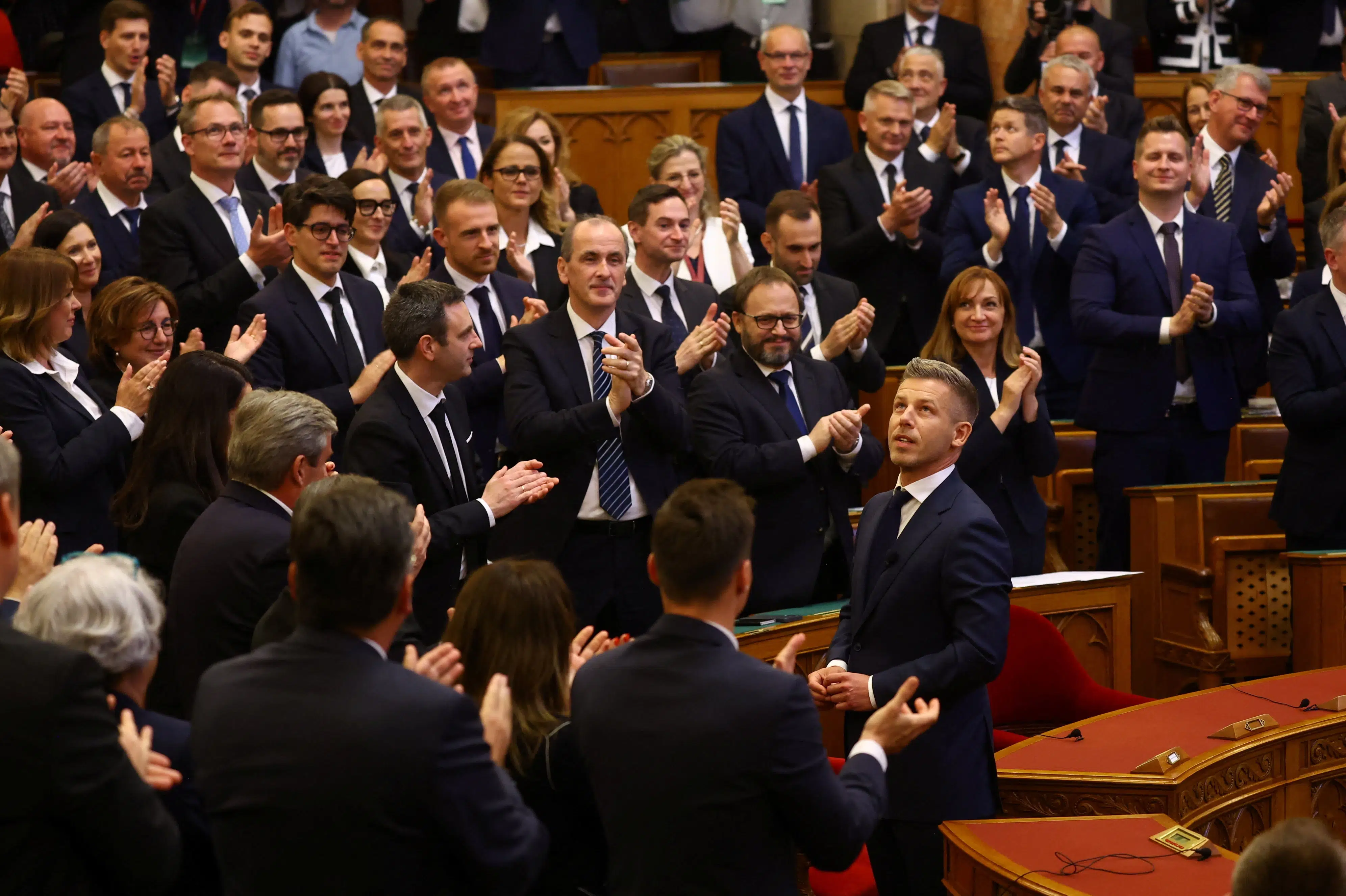
Péter Magyar Sworn in as Hungary's New Leader
Translated from Danish, summarized and contextualized by DistantNews.
TLDR
- Péter Magyar was sworn in as Hungary's new prime minister on Saturday.
- Magyar's party, Tisza, defeated Viktor Orbán's Fidesz party in the April parliamentary elections.
- Tisza, founded in 2020, gained prominence after Magyar joined and became chairman in 2024, campaigning against corruption and advocating for closer EU ties.
Hungary has entered a new political era as Péter Magyar was officially sworn in as the nation's prime minister. This marks a significant shift after 16 years under Viktor Orbán's leadership, with Magyar's Tisza party securing a decisive victory in the April parliamentary elections.
Magyar, a former member of Orbán's Fidesz party, positioned himself as a reformer, campaigning on an anti-corruption platform and promising to steer Hungary closer to the European Union. His party, Tisza, though established in 2020, only surged to prominence after Magyar took the helm in early 2024, capitalizing on public discontent and a desire for change.
The Tisza party's platform extends beyond tackling corruption to include improvements in public services, particularly healthcare, and a firm stance on migration policy. This agenda signals a potential recalibration of Hungary's domestic priorities and its relationship with the EU, contrasting with the Fidesz party's often contentious interactions with Brussels.
From a Hungarian perspective, this transition represents a moment of profound change. While Western media might focus on the ousting of Orbán, Hungarians are keenly aware of the internal dynamics and the specific promises Magyar has made regarding domestic issues like healthcare and corruption. The success of Tisza reflects a complex mix of desires for reform, a renewed engagement with European partners, and a critical look at the established political order. The coming months will be crucial in determining whether Magyar can deliver on his ambitious agenda and reshape Hungary's future.
DistantNews Editorial
Originally published by Berlingske in Danish. Translated, summarized, and contextualized by our editorial team with added local perspective. Read our editorial standards.
More Stories


From Our Blog

What Gets Lost (and Found) When News Is Translated

The Critical Role of Diaspora Media in Global News

What Travellers Should Know About Countries with Restricted Press

A Digital Nomad's Guide to Following Local News

How the Same Story Looks Different in Different Countries
