

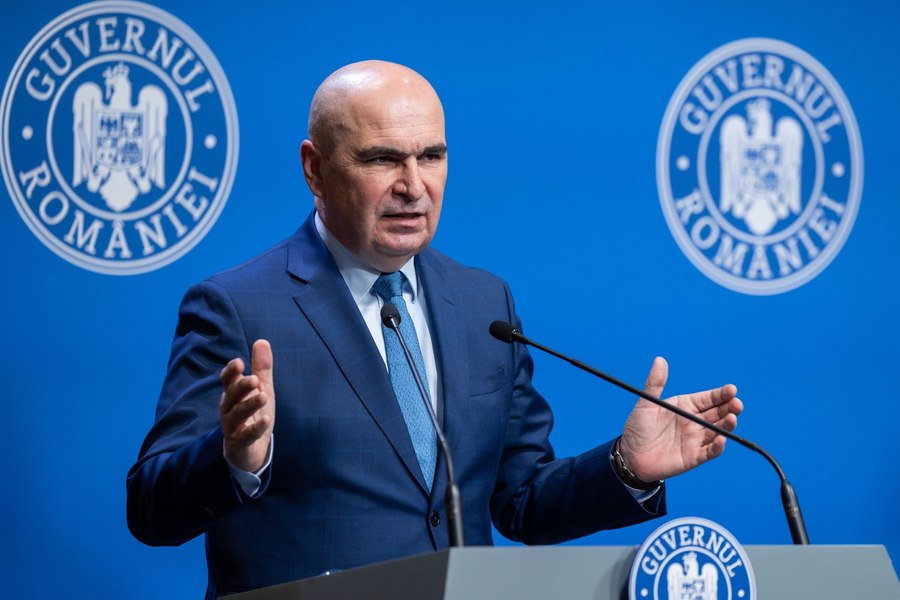
PM Bolojan: PNL Can Govern Without PSD, Minority Government Possible
Translated from Romanian, summarized and contextualized by DistantNews.
TLDR
- Romanian Prime Minister Ilie Bolojan stated that his party, PNL, can govern again but not in a coalition with PSD.
- He suggested the possibility of a new parliamentary group supporting a minority government, emphasizing PNL's responsibility and refusal to accept a
As a publication deeply embedded in the Romanian political landscape, Adevărul reports on Prime Minister Ilie Bolojan's strategic maneuvering with a keen eye on the nation's stability and PNL's political future. Bolojan's assertion that PNL can govern again, but explicitly not with PSD, signals a clear redrawing of political lines. This stance, while firm, also opens the door to complex parliamentary dynamics, including the potential emergence of a minority government supported by a new bloc.
We are responsible people and we have not shied away from taking responsibility. In the situation where such a consultation could take place after a motion, we will obviously take the mandate from the PNL leadership, we will go before the president and state our point of view. This point of view can only be one that is consistent with the decisions already made. And that means we can be in government, but we can no longer be in a coalition with PSD.
The Prime Minister's rhetoric highlights a desire for responsible governance, rejecting the idea of a 'puppet premier' dictated by PSD. This reflects a broader Romanian political narrative where party autonomy and strong leadership are highly valued. Bolojan's willingness to consider alternative alliances, even forming a 'modernization pole' from opposition, underscores the fluid nature of Romanian politics and the constant search for viable governing coalitions.
If they (PSD) had assumed responsibility, if they had been statesmen and assumed responsibility for these positions, but they did not do so, then, obviously, PNL must look for an alternative, in such a way that we build... which, in an extreme situation, can also be built from opposition.
Furthermore, Bolojan's acknowledgement that many parliamentarians are 'starting to understand Romania's problems' hints at a potential shift in political allegiances, driven by a perceived need for pragmatic solutions over partisan squabbles. The mention of a scenario similar to the UNPR's past support for a government suggests that unconventional alliances are not out of the question in Romania's often fragmented political scene. This article, from our perspective at Adevărul, captures a pivotal moment where the government seeks to navigate a path forward amidst political uncertainty, prioritizing national interest as defined by PNL.
Of course, many parliamentarians who entered on different lists are beginning to understand what Romania's problems are and what can truly be done in the future. I have tried during this entire period not to create expectations that cannot be met, to tell Romanians what path we have to take to fix things.
DistantNews Editorial
Originally published by Adevărul in Romanian. Translated, summarized, and contextualized by our editorial team with added local perspective. Read our editorial standards.
More Stories
From Our Blog

What Gets Lost (and Found) When News Is Translated

The Critical Role of Diaspora Media in Global News

What Travellers Should Know About Countries with Restricted Press

A Digital Nomad's Guide to Following Local News

How the Same Story Looks Different in Different Countries
