


PM warns of growing climate risks as scientists flag more glacial disasters
Summarized by DistantNews. Read the original for the full story.
At a glance
News
Named sources
Ongoing story
- Nepal’s Prime Minister Balendra Shah urged the international community to treat the August 26 Bhotekoshi flood as a warning of rising climate risks in the Himalayas.
- The disaster killed 1,204 people, left 4,216 out of contact and directly affected about 1.6 million people in Rasuwa and Nuwakot, according to Nepal’s disaster authority.
- Chinese climate scientists warned that glacier-related disasters could become more frequent as warming weakens glaciers on the Qinghai-Xizang Plateau.
Prime Minister Balendra Shah has urged the international community to see the August 26 flood in Nepal’s Bhotekoshi River as a warning that Himalayan climate risks are intensifying.
Speaking to Nepal’s House of Representatives on Wednesday, Shah said experts had linked the flood in Rasuwa to a massive rockslide in the Himalayan region. “The incident is a serious indication that the risks we face in the Himalayan region are increasing,” he said.
The incident is a serious indication that the risks we face in the Himalayan region are increasing.
Shah said Nepal needed to communicate more forcefully that climate change was driving the disasters it faces. “Climate change is a global problem,” he said. “Mitigating and managing its impacts is a shared responsibility of the international community.”
Climate change is a global problem. Mitigating and managing its impacts is a shared responsibility of the international community.
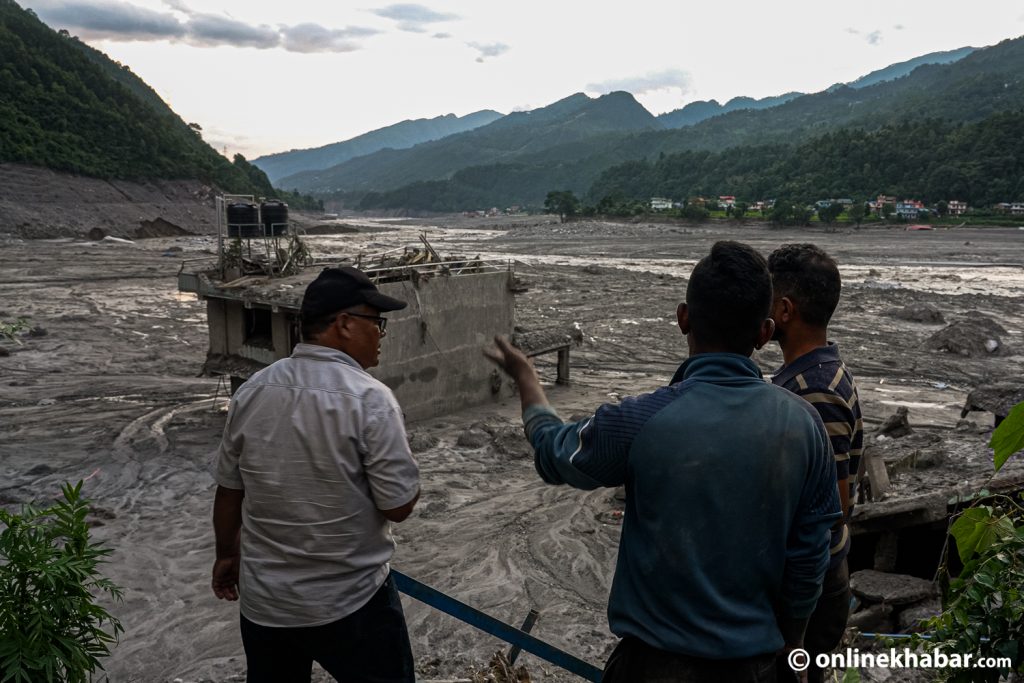
The remarks came as search-and-rescue operations continued. Scientists and climate experts on both sides of the Nepal-China border were still examining what triggered the disaster and whether similar events could become more frequent. Nepal’s National Disaster Risk Reduction and Management Authority said the death toll had reached 1,204 by Wednesday evening, with 4,216 people still out of contact. About 1.6 million people in Rasuwa and Nuwakot were directly affected. The floods swept away 41 concrete bridges and damaged four more. In Nuwakot, 1,267 homes were destroyed and another 1,253 sustained partial damage.
The disaster has also focused attention on the stability of the Himalayan cryosphere as temperatures rise. China’s National Climate Centre said glacier-related disasters could increase as global warming weakens glaciers on the Qinghai-Xizang Plateau. Gao Rong, the centre’s deputy director, said glaciers across the plateau and surrounding areas were undergoing accelerated melting in a warmer and wetter climate. “Glacier-related disasters could become more frequent and trigger cascading effects that amplify the scale of destruction and expand their impact,” Gao warned.
Glacier-related disasters could become more frequent and trigger cascading effects that amplify the scale of destruction and expand their impact.
About this summary
Originally published by Kathmandu Post. Summarized and contextualized automatically by DistantNews, with a note on how the source frames the story. Not individually reviewed before publishing. How this works.
More Stories

From Our Blog

What Gets Lost (and Found) When News Is Translated

The Critical Role of Diaspora Media in Global News

What Travellers Should Know About Countries with Restricted Press

A Digital Nomad's Guide to Following Local News

How the Same Story Looks Different in Different Countries
