


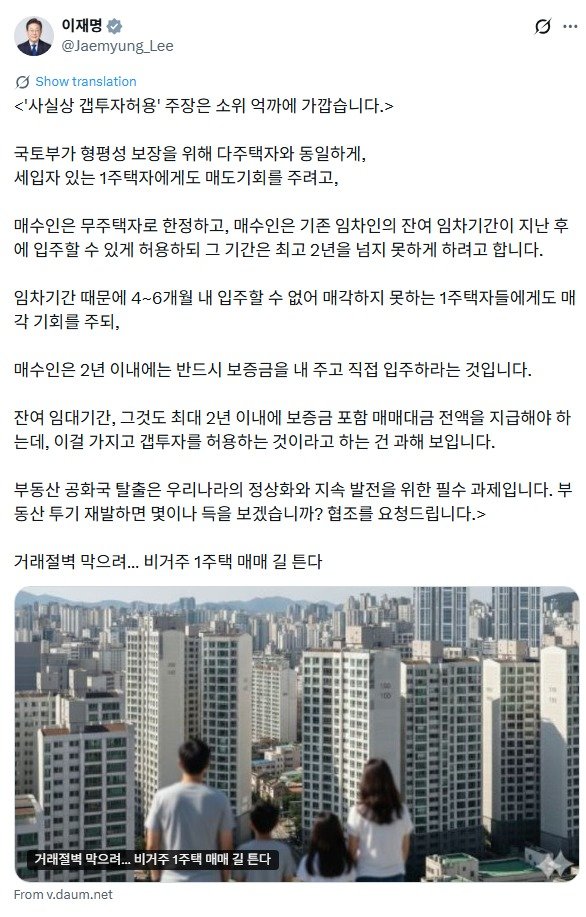
President Lee Refutes 'Gap Investment' Claims on Property Permit Review
Translated from Korean, summarized and contextualized by DistantNews.
TLDR
- South Korean President Lee Jae-myung refuted claims that his administration's review of property transaction permits for non-resident single-homeowners would effectively allow 'gap investment'.
- He clarified that the proposed measure aims to provide a selling opportunity for single-homeowners with existing tenants, similar to multi-homeowners, with buyers restricted to non-homeowners and requiring move-in within two years.
- President Lee stressed that escaping the 'real estate republic' is essential for national normalization and sustainable development, urging cooperation to prevent speculative reinvestment.
Seoul, South Korea – President Lee Jae-myung has strongly refuted criticisms suggesting that his administration's consideration of exceptions to property transaction permit rules for non-resident single-homeowners would amount to a de facto allowance of 'gap investment.' The term 'gap investment,' or 'gap-투자,' refers to a speculative practice where an investor buys a property by leveraging the difference between the purchase price and the existing rental deposit, without significant personal capital. Critics argued that allowing such transactions would fuel speculation, particularly among those who are not first-time homebuyers.
The proposal to review exceptions to property transaction permits for non-resident single-homeowners is close to fabricating an attack ('억까').
President Lee took to his social media platform, X (formerly Twitter), to address these concerns, characterizing the accusations as "close to fabricating an attack" ('억까'). He explained that the Ministry of Land, Infrastructure, and Transport's proposal aims to ensure fairness in selling opportunities. Under the proposed plan, single-homeowners with existing tenants would be granted a selling opportunity akin to multi-homeowners. However, the buyers would be strictly limited to non-homeowners, and they would be required to move into the property after the current tenant's lease expires, with a maximum period of two years. "The buyer must pay the full purchase price, including the deposit, within two years and move in directly," President Lee stated, adding that labeling this as allowing 'gap investment' seemed excessive.
The Ministry of Land, Infrastructure, and Transport is considering exceptions for non-resident single-homeowners from the perspective of fairness in selling opportunities, similar to multi-homeowners.
The President reiterated his administration's commitment to normalizing the real estate market, a goal he deems essential for the nation's sustainable development. He questioned the benefits of allowing real estate speculation to resurface, emphasizing the need for cooperation from all parties. This move by the Lee administration reflects a complex balancing act: attempting to provide liquidity and fairness in the property market without reigniting the speculative bubbles that have plagued South Korea. The perspective from Seoul is one of cautious optimism, hoping these measures will facilitate a more stable housing market, while acknowledging the persistent challenges of managing real estate speculation in a highly competitive environment. The focus remains on preventing a return to the 'real estate republic' era, where property speculation overshadowed genuine economic growth.
The buyer must pay the full purchase price, including the deposit, within two years and move in directly. Labeling this as allowing 'gap investment' seems excessive.
DistantNews Editorial
Originally published by Dong-A Ilbo in Korean. Translated, summarized, and contextualized by our editorial team with added local perspective. Read our editorial standards.
More Stories


From Our Blog

What Gets Lost (and Found) When News Is Translated

The Critical Role of Diaspora Media in Global News

What Travellers Should Know About Countries with Restricted Press

A Digital Nomad's Guide to Following Local News

How the Same Story Looks Different in Different Countries
