


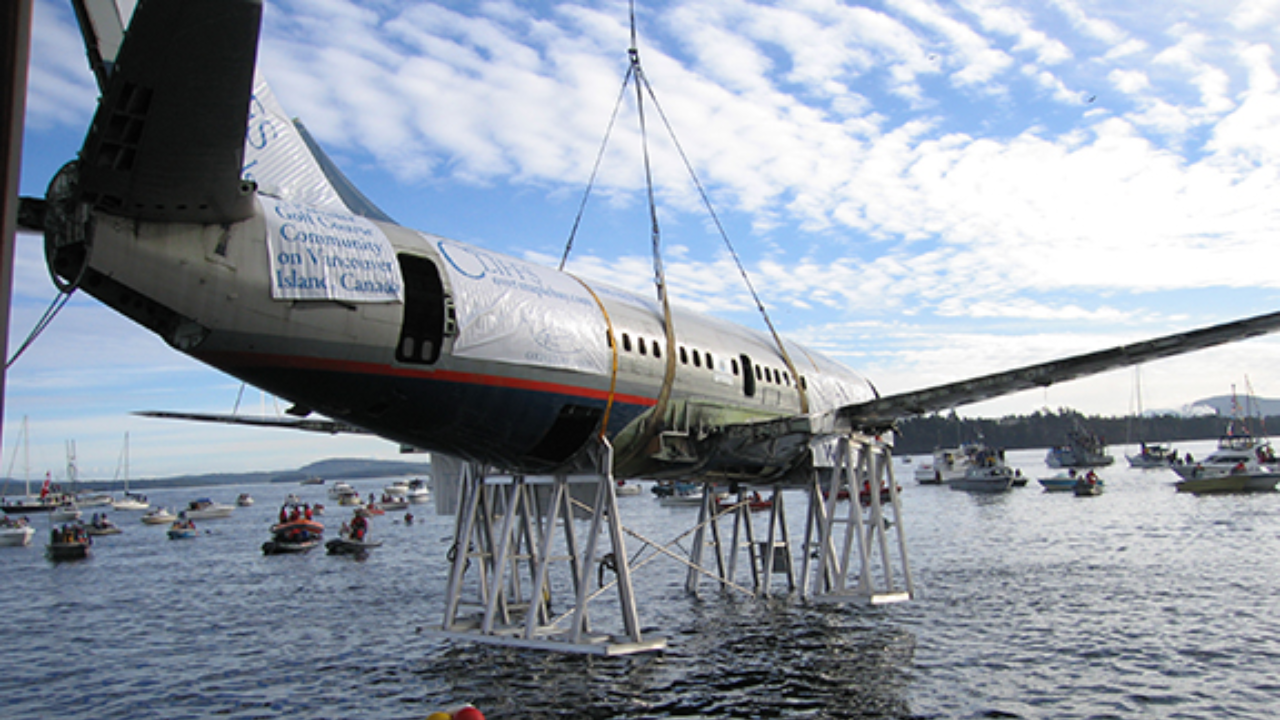
Retired Boeing 737 becomes artificial reef off Vancouver Island
Translated from English, summarized and contextualized by DistantNews.
At a glance
In-depth
Sources not specified
Outcome reported
- A retired Boeing 737 aircraft was sunk off Vancouver Island to create an artificial reef.
- The plane, formerly part of Canadian Airlines, now hosts diverse marine life.
- The project aimed to revitalize an area affected by pollution and over-fishing.
A retired Boeing 737 aircraft, once part of the Canadian Airlines fleet, now rests nearly 90 feet underwater off the coast of Vancouver Island, serving as an artificial reef for marine life.
The 100-foot jet was decommissioned by Air Canada due to age and structural issues. After being stripped of all usable components, the airframe was donated to the Artificial Reef Society of British Columbia (ARSBC) and sunk near Chemainus, British Columbia, on January 14, 2006.
Known as 'Xihuw,' a Hul'qumi'num word for red sea urchins, the aircraft was donated through the efforts of Air Canada and Qwest Airparts of Memphis, Tennessee. The red sea urchin population in these waters has significantly declined due to pollution and over-fishing, making the reef's creation a targeted effort to support marine ecosystems.
The project involved extensive planning, including securing approvals from Environment Canada and six local First Nations. Volunteers dedicated hundreds of hours to meticulously cleaning the fuselage, removing grease, insulation, and any residual pollutants to prevent toxic leaching into the marine environment.
After nearly four years of planning, the aircraft was mounted on 11-foot-high support stands and lowered by crane into the Georgia Strait. The chosen site, lacking significant marine life due to past industrial debris, has since seen a resurgence. Cloud sponges, plumose anemones, feather stars, octopuses, and red sea urchins have colonized the wreck, with over a hundred documented species now inhabiting the artificial reef.
DistantNews Editorial
Originally published by Times of India in English. Translated, summarized, and contextualized by our editorial team with added local perspective. Read our editorial standards.
More Stories
From Our Blog

What Press Freedom Means for the News You Read

What Gets Lost (and Found) When News Is Translated

The Critical Role of Diaspora Media in Global News

What Travellers Should Know About Countries with Restricted Press

A Digital Nomad's Guide to Following Local News
