

Senegal Assembly Passes Controversial 'Sonko Law' Amid Eligibility Debate
Translated from French, summarized and contextualized by DistantNews.
TLDR
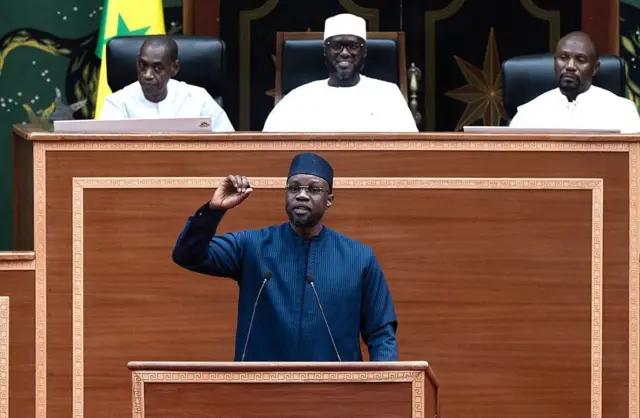
- Senegal's National Assembly passed a controversial law on April 28 that opponents claim is tailored to ensure Prime Minister Ousmane Sonko's eligibility for the next presidential election.
- Sonko, a former opposition leader, was previously deemed ineligible due to a judicial conviction, a decision upheld by the Supreme Court in July 2025.
- The new law, passed with a strong majority by the PASTEF-dominated parliament, aims to remove this ineligibility, pending a decision from the Constitutional Council on the principle of retroactivity, which the opposition plans to challenge.
The recent vote in Senegal's National Assembly on the "Sonko Law" has ignited a firestorm of debate, and rightly so. This legislation, rushed through with a significant majority, is widely perceived as a bespoke solution designed to clear the path for Prime Minister Ousmane Sonko's presidential ambitions. While proponents may frame it as a necessary step to rectify an injustice, the optics are undeniable: a law seemingly crafted to bypass a judicial disqualification.
C’est une loi plutôt controversée qui a été votée, le 28 avril dernier, au Sénégal, par l’Assemblée nationale, en ce qu’elle est vue comme une loi « taillée sur mesure » pour le chef du gouvernement, Ousmane Sonko, en vue de garantir son éligibilité à la prochaine présidentielle.
Sonko, a figure who galvanized significant popular support, faces a lingering ineligibility stemming from a past conviction. The Supreme Court's refusal to overturn this ruling in July 2025 left a shadow over his political future. This new law, however, attempts to lift that shadow, a move that has predictably drawn sharp criticism from opposition factions and even some within the ruling majority. They decry it as a manipulation of the legal framework for political gain.
Une condamnation qui pèse toujours sur sa tête ; d’autant plus que la Cour suprême avait rejeté, en juillet 2025, son recours en rabat d’arrêt de ladite sentence.
The speed and manner of its passage, particularly through an emergency procedure in a parliament overwhelmingly dominated by Sonko's PASTEF party following the November 2024 early legislative elections, only amplify these concerns. The assertion that this law is merely a "victory in progress" for Sonko, who propelled President Bassirou Diomaye Faye into office, rings hollow for many. The core of the controversy lies in the principle of retroactivity, a legal concept the opposition vows to challenge before the Constitutional Council.
C’est cette épée de Damoclès suspendue sur la tête de celui qui est connu pour avoir été le mentor du président Bassirou Diomaye Faye dans un passé récent, que vise à enlever le vote de cette loi qui fait des gorges chaudes au pays de la Teranga.
From our perspective at Le Pays, this situation highlights a recurring tension in Senegalese politics: the interplay between popular will, judicial pronouncements, and legislative maneuvering. While international observers might focus on the democratic implications, for us, it's about the immediate political calculus and the potential for heightened instability. The looming question is whether this legislative maneuver will ultimately strengthen Sonko's position or further polarize the nation, especially as President Faye must now contend with the renewed possibility of his former mentor challenging him for the presidency.
les législatives anticipées de novembre 2024, qui ont été organisées dans la foulée de l’élection du président Bassirou Diomaye Faye pour la succession de Macky Sall, ont consacré l’émergence d’un parlement dominé par le PASTEF qui a remporté 130 des 165 sièges qui étaient en jeu ?
DistantNews Editorial
Originally published by Le Pays in French. Translated, summarized, and contextualized by our editorial team with added local perspective. Read our editorial standards.
More Stories

From Our Blog

What Gets Lost (and Found) When News Is Translated

The Critical Role of Diaspora Media in Global News

What Travellers Should Know About Countries with Restricted Press

A Digital Nomad's Guide to Following Local News

How the Same Story Looks Different in Different Countries
