


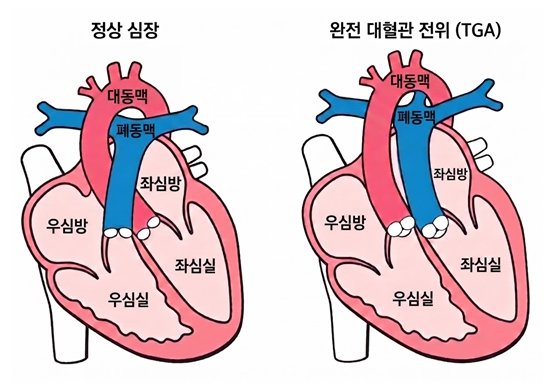
South Korean Study Reveals 90% 30-Year Survival Rate for Complex Heart Condition Surgery
Translated from Korean, summarized and contextualized by DistantNews.
TLDR
- A study tracked 1,125 patients who underwent arterial switch operations for complete transposition of the great arteries over 30 years.
- The research found a 90% survival rate up to 30 years post-surgery, with varying outcomes based on anatomical characteristics.
- Findings indicate a shift in common complications over time, from right-sided issues early on to left-sided issues later, informing future patient management strategies.
A groundbreaking study from South Korea, involving a collaboration of researchers from Seoul National University Hospital and Chonnam National University Hospital, has provided unprecedented insights into the long-term prognosis of patients with complete transposition of the great arteries (TGA). This extensive research, tracking 1,125 patients for up to three decades, reveals a remarkable 90% survival rate, offering significant hope and crucial data for managing this complex congenital heart defect.
This study is academically significant in that it analyzed the prognosis for up to 30 years by constructing the world's largest-scale cohort.
The study, published in the Canadian Journal of Cardiology, meticulously analyzed survival rates, re-intervention rates, and structural complications across different patient subgroups. It found that while overall survival is high, specific anatomical variations, such as the Taussig-Bing anomaly, are associated with relatively lower survival rates. Furthermore, the research identified critical risk factors, including the need for mechanical circulatory support and early re-operations, which significantly impact mortality risk. This granular data is vital for tailoring treatment and follow-up care.
Especially since we confirmed that the pattern of complication occurrence changes over time, it will serve as important evidence for establishing personalized management strategies for patients throughout their lifespan.
What makes this research particularly significant from a Korean perspective is its scale and duration, representing the largest cohort study of its kind globally. It addresses a critical gap in long-term data for TGA patients, which has historically limited the development of comprehensive lifelong management strategies. The findings underscore the importance of ongoing monitoring, as the nature of complications evolves over time – shifting from right-sided issues in the early post-operative period to left-sided complications, such as aortic root dilation, in the long term. This temporal shift in complications highlights the need for age-specific, personalized care plans, a crucial takeaway for clinicians and patient advocacy groups in Korea and beyond.
This study is a meaningful achievement that systematically analyzed the long-term prognosis of congenital heart disease patients through multi-institutional collaboration in Korea.
DistantNews Editorial
Originally published by Dong-A Ilbo in Korean. Translated, summarized, and contextualized by our editorial team with added local perspective. Read our editorial standards.
More Stories


From Our Blog

What Gets Lost (and Found) When News Is Translated

The Critical Role of Diaspora Media in Global News

What Travellers Should Know About Countries with Restricted Press

A Digital Nomad's Guide to Following Local News

How the Same Story Looks Different in Different Countries
